


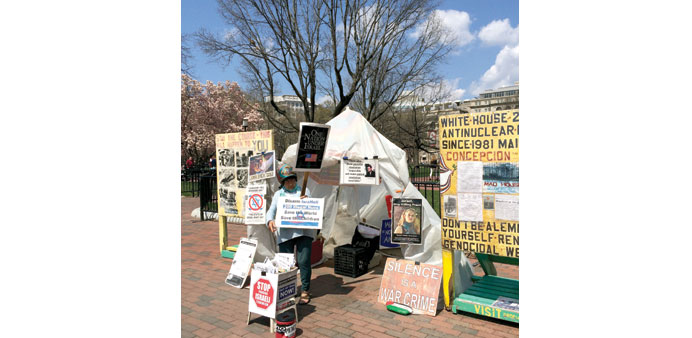
Jay Jayaraj shares the story of a popular figure, who has dedicated her lifetime’s protest
to saving the world’s children outside the famed white mansion, and the cherry blossoms
When tourists are done posing for the perfect shot with the famed White House on the background, they’d stop in the vicinity for something else that has become iconic over the years.
Most probably, they were unaware of it before arriving at the Lafayette Park but once there, they can’t help but develop a varied mental reaction to what they see. Reaction is usually mixed but people are mostly always in awe of the character who has been keeping vigil outside the white mansion through summers and winters for more than three decades.
That character is 78-year-old Concepcion Picciotto. The little lady, a bundle of slighty under five feet, is of Spanish origin. Her shelter is a shed of an old garden umbrella covered in white plastic sheets, held in place by binder clips — a stark contrast to the neighbouring White House.
Visibly aged and shrunk from the years of keeping herself outdoors, Picciotto has a frail but steady voice to match her unbroken spirit. All wrapped up, holding a placard in her hand, she hands me a photocopy of a 1988 article about her, headlined A life of protest. Without doubt, it is.
Thirty years is someone’s lifetime and it’s a long time to be stationed at one location and protesting over issues pertaining to world peace and justice for mankind, almost single-handedly.
A tour guide tells me and a few other tourists that Picciotto is there all day, 24/7, doing her thing. When she isn’t around, she is at a shelter for activists while someone else takes over. I learnt later that Picciotto’s long and complicated story began with her trying to get custody over her daughter, which led to a protester and friend, William Thomas who was for peace and anti-nuclear protests.
Together, they were a team for those causes, and Picciotto’s personal quest developed into saving the children of the world when the prospect of getting to her own child dimmed. The vigil officially began in 1981.
Like many other tourists, I am not expecting for characters like Picciotto to pop up when I get off the bus at the Lafayette Park, of course. But her story quickly becomes a highlight during my three hours in Washington DC.
As someone who is squeezing in some tours off New York City during a short holiday, I have limited hours at a location, and as much as I dislike going on a rushed tour, Washington DC is worth the ride. The cherry blossoms are in season, decorating most of Washington parks in clouds of large, pink and white blooms and it has its long, complicated story as well.
The first batch of 2000 cherry blossoms arrived in Washington DC from Japan as a gift in 1910, marking a symbol of friendship from Japan. However, the trees were rendered unfit after a check by the Department of Agriculture and ordered to be destroyed.
Taking no offence at that, the Japanese then sent another batch of trees. In 1912, about 3000 cherry trees, comprising a few varieties arrived and was transferred to Washington. First lady Helen Taft and Viscountess Iwa Chinda, wife of the Japanese ambassador, planted two Yoshino cherry trees on the bank of the Tidal Basin, now known as the Independence Avenue.
The other varieties were planted around the Tidal Basin and East Potomac Park. Later in the mid-60s, First Lady Bird Johnson and Japanese ambassador’s wife Ryuji Takeuchi would re-enact this ceremony when Japan donated 3800 Yoshino trees to beautify Washington.
It’s interesting how things have progressed from there. The first Cherry Blossom festival, sponsored by a few civic groups, took place in 1935 and today it’s one of the biggest annual events in Washington DC that both locals and tourists look forward to.
The symbol of friendship suffered a blow in 1941 during the invasion of Pearl Harbour by the Japanese when several trees were cut down in an act of vandalism. To prevent such incidents in the future, officials even began calling it the “oriental’ cherry blossoms.
The friendship symbol reinforced itself when the cherry tree grove along the Arakawa River in Japan, which were also the parent trees of Washington’s first trees, had suffered during World War II. The National Park Service had then sent some budwood of the Washington trees to Tokyo in the restoration efforts upon Japan’s request in 1952. Again in the early 80s, Japanese horticulturists collected several hundred cuttings from the Tidal Basin trees for restoration purposes when the river course had changed.
As the cherry trees only have an average four-decade lifespan, much has been done over the years to preserve and maintain the trees via various efforts and means including cloning the originals. Cuttings from the surviving 1912 Yoshino trees were taken to ensure the genetic preservation of the lineage in cooperation with the National Arboretum.
Visitors are also advised to help care for the sensitive trees by not breaking a twig of the blossoms as new flowers will not grow from a broken part again. While it may be hard to suppress the urges of wanting to pick a flower for its sheer beauty, a guide explains to me why it’s important not to snap a twig or even walk around a tree base.
Who knew that a compacted ground as a result from the daily impact from hundreds of people could damage the trees’ ability to absorb water for longevity and general well-being. Still, that doesn’t keep some tourists from doing exactly that.
I have to admit that I never feel like a first-time visitor being in Washington DC, sight-seeing and touring the iconic buildings. Hollywood had made these landmarks so familiar in one’s mind that when I glance over at the Lincoln Memorial and the Washington Monument from the Reflecting Pool, it feels like I’ve been there many times before.
Indeed, I have watched them in countless movies and TV shows. Turns out it isn’t just me who feels that way but most tourists who are familiar with American shows share the sentiment as well.
“When I go to these places, I feel like I’ve been there before. It doesn’t feel new to me but there is always the excitement of actually being here to experience these for real after all those movies and television shows. It’s like I’ve known these places and the culture for a long time,” says an excited Asian tourist to me.
My three hours in Washington DC also included visits to the Capitol Hill, Vietnam Veterans’ Memorial, Smithsonian National Air and Space Museum, Korean War Veterans’ Memorial and the National Archives. It’s time well-spent indeed despite the travelling hours.