


By Joey Aguilar
Top airline CEOs have debunked claims that a huge order of planes worldwide may result in a glut in future, stressing that all planes will be “deployed accordingly” in various operations.
CNN’s Richard Quest, who was moderating a panel discussion at the 70th International Air Transport Association (IATA) Annual General Meeting, was raising the issue of possibly having an overcapacity with an 11,000 planes on order while the current fleet worldwide is only at 21,000.
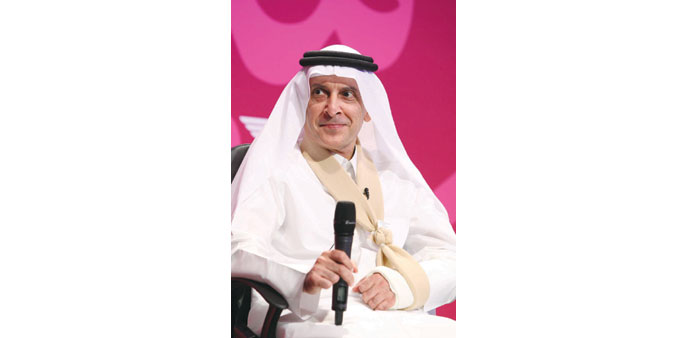
Responding to the question, Qatar Airways CEO Akbar al-Baker expressed confidence that there will be no excess in plane capacity since airline companies do not buy planes “to park and put them in the hangar to look at them.”
“They buy it because there is a requirement, they have a plan and they have a deployment programme,” he said.
For Qatar Airways alone, al-Baker noted that they have a huge requirement of fleet replacements, about 150 planes will be replaced over the next 10 years. He said the airline was buying a total of 300 planes.
He cited the case in the US, Europe, Africa and other parts of the world where replacement is also huge because of the increasing demand for flights.
CEOs argue that many of the orders are replacements since some planes may already have issues of inefficiency.
For Cathay Pacific CEO Ivan Chu, overcapacity may pose a big challenge to the industry but it could be addressed by being flexible.
“The keyword is flexibility. While the market rises, we will use new aircraft to meet market demands,” he noted. “When you have a plan for the future you have to have flexibility.”
But for air freight capacity which also need plane replacements, excessive supply will likely happen in the next few years.
About joint ventures, International Airlines Group Chief Executive Willie Walsh said it works in certain markets with certain partners; becoming more of a feature of the alliance structure. “But it is not the norm yet.”
Some airlines have expressed intention to have joint ventures with others in the future to meet certain demands.
JetBlue Airways CEO David Barger agrees that such mergers play an important role especially in the business side.
“Lufthansa has 16 percent of our company. It was so important to us going into some really difficult times and being partner with a global airline,” he added. “The reality is we have joint ventures because it is recognised by the regulators.”
For al-Baker who was asked if he is willing to invest in US airlines, he stressed that they will only invest in successful airlines and not on failures.
For Dragonair, Chu said their relationship with Air China had worked well, which owns 20% of the former.
About bilateral and multilateral relationships, Aeromexico CEO Andres Conesa Labastida and Chu said these two play an important role in increasing profitability in the future.
Chu believes bilateral is useful on the business side while multilateral works on things beneficial to customers.
Some industry issues such as the increasing prices of fuel and how it affects profitability were also tackled during the discussion.
Air cargo carriers battle competition from seas, passenger planes
As more cargo shifts to passenger planes and back onto the seas, airlines are having to rethink their cargo operations or risk the freighter plane becoming a thing of the past.
While some carriers have already reduced the number of freighter planes they operate, more drastic changes to shorten transport times and regain ground lost to the shipping industry are needed, delegates at an annual airline meeting in Doha said.
Air freight built a reputation for getting bulky, expensive goods from A to B as quickly as possible. Even today, the $6.8tn worth of goods transported by air cargo every year represents 35% of international trade by value but only 0.5% of total volumes.
But as paperwork has increased, the average time it takes to shift a product from the manufacturer to the final importer stands at 6.5 days, compared with Lufthansa Cargo’s boast in the 1960s that the process took only three days.
High value goods such as electronics have also become smaller, meaning they take up less space and do not need dedicated freighters for transportation.
These trends are pushing companies such as AstraZeneca, Ericsson and Sony to transport more of their pharmaceuticals and electronics via sea at lower cost. In addition, growing demand for plane travel means more and more freight is being transported in the holds, or bellies, of passenger planes.
The International Air Transport Association, meeting this week in Doha, predicts cargo volumes will total about 52mn tonnes this year, effectively unchanged since 2010. “The industry needs a structural redesign,” Glyn Hughes, director of cargo industry management at IATA, said yesterday.
Airlines have so far reacted to the tough cargo market by cutting capacity and taking freighters out of service. “Most are losing money and they respond by cutting capacity to try to break even to survive this slump,” said Andrew Herdman, director-general of the Association of Asia Pacific Airlines.
Lufthansa Cargo has postponed a decision on whether to take more Boeing 777 freighters. Other carriers such as Air France-KLM, Singapore, Japan Airlines have all reduced the number of freighter planes they operate.
Air France-KLM — whose passenger aircraft currently account for 72% of total freight capacity compared with 54% in 2007-08 — plans to make a decision in a couple of weeks on whether to reduce its fleet of freighter-only aircraft further, chief executive Alexandre de Juniac said at the meeting. The carrier has already cut its freight-only capacity by 11.5% to 14 aircraft in 2013. But to better compete in the long term, airlines need to cut shipping times and position themselves as premium operators specialising in high value or perishable goods, such as flowers, or bulky oversized goods, delegates said.
“Something has to change to deal with the overcapacity,” Jonathan Kletzel, Transportation and Logistics Leader at PwC, told Reuters. He said the freighter-only carriers should make the most of the fact they can also offer routes outside the designated passenger networks and should look at improving links with other forms of transport.
IATA wants its members to shave 48 hours off shipping times — pointing out that of the 6.5 days on average it takes to get air freight from door to door, only a few hours is actually spent in the air.
It is therefore encouraging airlines to simplify procedures with freight forwarders and ground handlers, and to cut down the amount of paperwork.