


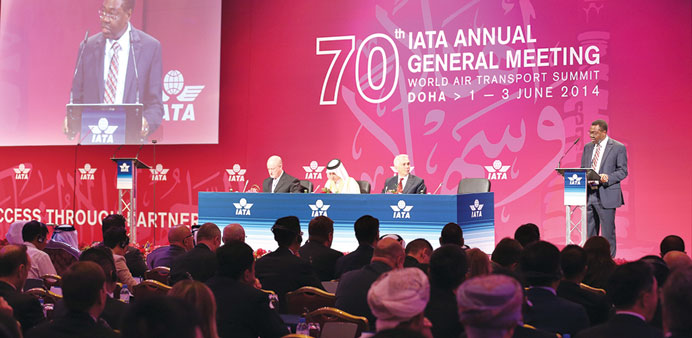
ICAO president Dr Olumuyiwa Benard Aliu addressing the opening session of the IATA annual general meeting in Doha.
The International Air Transport Association (IATA) 70th Annual General Meeting (AGM) in Doha yesterday unanimously adopted a resolution that calls on governments and industry to work together on a balanced package of measures to effectively deter and manage the problem of unruly air passenger behaviour.
“Such behaviour includes committing physical assault, disturbing good order on board, and failing to follow lawful crew instructions,” the IATA said.
“This resolution confirms the determination of airlines to defend the rights of their passengers and crew. Everybody on board is entitled to enjoy a journey free from abusive or other unacceptable behaviour,” said IATA director-general and chief executive Tony Tyler. “Many airlines have trained both ground staff and cabin crew in procedures not only to manage incidents of unruly behaviour but also in measures to prevent them. But a robust solution needs alignment among airlines, airports, and governments.”
The adoption of the AGM resolution follows a Diplomatic Conference called by the International Civil Aviation Organisation (ICAO), at which governments agreed to modernise and strengthen the Tokyo Convention of 1963.
The result, known as the Montreal Protocol 2014 (MP14), provides a more practically effective deterrent to unruly behaviour by extending the legal jurisdiction for such events to the territory in which the aircraft lands.
“Governments have recognised that unruly passenger behaviour is a serious issue and we applaud the adoption of MP14 at an ICAO Diplomatic Conference earlier this year. Now, governments must ratify what they have agreed to,” said Tyler.
The definition of unruly behaviour is wide and includes non-compliance with crew instructions, consumption of illegal narcotics, sexual harassment, and physical or verbal confrontation or threats.
In 2013, the number of incidents of unruly behaviour voluntarily reported to IATA by airlines reached 8,000 cases.
Intoxication, often resulting from alcohol already consumed before boarding, ranks high among factors linked to these incidents.
Other causes include irritation with another passenger’s behaviour, frustration with rules such as smoking prohibitions or use of electronic devices or emotional triggers originating prior to flight.
“Each incident of unruly behaviour marks an unacceptable inconvenience to passengers and crew. A united and balanced approach to the prevention and management of unruly passengers by governments and industry is vital,” Tyler said.
“Governments should adopt all the legal powers at their disposal to ensure unruly passengers face the appropriate consequences for their actions. Airlines, airports, and others must work together to implement the right procedures and train staff to respond effectively to such instances,” he added.