


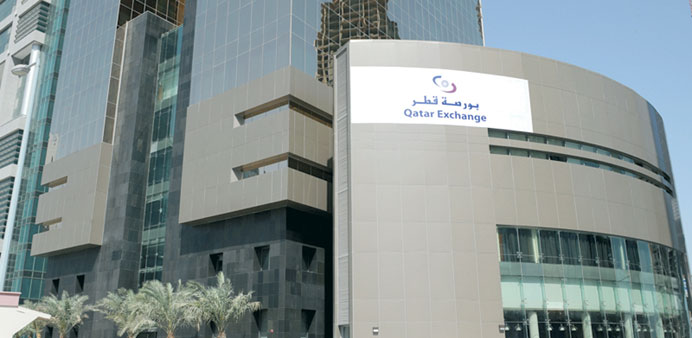
The Qatar Stock Exchange yesterday failed to break the 13,700 level, a day after it broke all record on being upgraded into emerging market index by global index compiler Morgan Stanley Composite Index (MSCI).
Profit-booking by foreign institutions largely masked the buying interests from domestic institutions as well as both Qatari and non-Qatari retail investors as the QSE gained a paltry 0.02%, amid falling volumes.
Despite stronger buying interests in the transport and telecom sectors, the 20-stock Qatar Index (based on price data) was up mere two points to 13,696.98 points.
However, market capitalisation shot up 0.4%, or about QR3bn, to 739.81bn. Mid cap equities gained 0.77%, while micro, small and large caps melted 0.63%, 0.56% and 0.13% respectively.
The index that tracks Shariah-principled stocks was seen melting compared to wee gains in the other indices in the market, which is up 31.96% year-to-date.
Opening strong, the market witnessed strong buying in the first 30 minutes to take the index near 13,850 levels, but strong profit-booking ensued for the next 15 minutes to drive the index to a low of 13,650 points intraday.
Regaining from the intermittent mild bearish grip, the market witnessed gains for the next 60 minutes to scale up to 13,750 levels, but there was a prolonged selling pressure for the next few hours. Some last minute buying, however, could not provide the much needed impetus as the index settled a tad below the 13,700 mark.
Overall, trading was skewed towards telecom, banks and real estate counters, which together accounted for more than 32% of the total volumes.
The 20-stock Total Return Index was up 0.02% to 20,425.15 points and the All Share Index (with wider constituents) by 0.01% to 3,424.17; while the Al Rayan Islamic Index shrank 0.74% to 4,604.44.
All the three indices factored in dividend income as well.
Although transport stocks surged 2.95%, followed by telecom (2.8%) and realty (0.09%); insurance fell 1.92%, consumer goods (1.02%), industrials (0.35%) and banks and financial services (0.3%).
Major movers included Industries Qatar, QNB, Vodafone Qatar, Milaha, Dlala, Ezdan, Ooredoo, Nakilat, Gulf International Services, Doha Insurance and United Development Company.
However, Qatar National Cement, Commercial Bank, Qatar Islamic Bank, Masraf Al Rayan, International Islamic, Aamal Company, Mazaya Qatar, Qatar Insurance and Mesaieed Petrochemical Holding Company bucked the trend.
Vodafone Qatar, Masraf Al Rayan and Barwa were the most active in terms of both volume and value.
Qatari retail investors turned net buyers to the tune of QR24.23mn against net sellers of QR453.79mn the previous day.
Non-Qatari individual investors were also net buyers to the extent of QR49.67mn compared with net sellers of QR86.63mn last Thursday.
Domestic institutions’ net selling plunged to QR20.59mn against QR792.07mn the previous day.
However, foreign institutions turned net profit-takers to the tune of QR53.47mn compared with net buyers of QR1.33bn last Thursday.
Total trading volume shrank 51% to 37.39mn stocks, value by 62% to QR1.73bn and transactions by 38% to 13,708.
The banks and financial services sector’s trading volume plummeted 60% to 11.81mn equities, value by 65% to QR779.91mn and deals by 43% to 4,791.
The market witnessed a 54% plunge in the industrials sector’s trading volume to 2.55mn shares, 67% in value to QR249.98mn and 44% in transactions to 2,100.
The telecom sector’s trading volume tanked 47% to 11.85mn stocks, value by 63% to QR321.5mn and deals by 41% to 2,737.
The real estate sector saw its trading volume decline 45% to 8.57mn equities, value by 49% to QR276.7mn and transactions by 28% to 2,717.
There was a 43% shrinkage in the transport sector’s trading volume to 1mn shares, 42% in value to QR30.24mn and 12% in deals to 466.
The insurance sector’s trading volume was down 10% to 0.36mn stocks, value by 24% to QR20.34mn and transactions by 14% to 176.
However, the consumer goods sector saw its trading volume gain 8% to 1.23mn equities but value fell 25% to QR51.91mn and deals by 15% to 721.
In the debt market, there was no trading of treasury bills and government bonds.
UAE markets retreat after MSCI move; Egypt sinks on tax
UAE stock markets pulled back yesterday after surging during the run-up to their upgrade by index compiler MSCI, while Egypt’s market continued to slide in response to the government’s plan for a capital gains tax.
Abu Dhabi jumped 5.5% and Dubai gained 5.0% last Thursday on large one-off purchases by passive funds that track MSCI’s emerging market index. MSCI added nine firms from the UAE and ten stocks from Qatar to the index on Friday, upgrading them from frontier market status.
As passive funds’ buying faded on Sunday, eight out of nine of the upgraded UAE stocks declined on profit-taking, the only exception being Aldar Properties, which added 0.2%. Port operator DP World, which trades on Nasdaq Dubai, led losses, tumbling 6.8%.
National Bank of Abu Dhabi and Abu Dhabi Commercial Bank fell 6.7% and 5.1% respectively, dragging down Abu Dhabi’s benchmark, which slid 1.8%.
Dubai’s bourse pulled back 0.6%, largely because of Emaar Properties, whose shares sank 3.8%.
“There is some residual buying from passive funds,” said Ali Adou, asset manager at The National Investor. “But those names (which jumped most on Thursday) are underperforming the market.”
Total traded value fell on both markets compared with Thursday, another signal that the peak of foreign fund inflows related to the MSCI adjustments had passed.
Kuwait could also expect fresh fund inflows from the MSCI decision because it became the biggest market in MSCI’s frontier market index as the UAE and Qatar exited that benchmark.
However, trading yesterday suggested the peak of inflows had passed in Kuwait too. The bourse’s blue-chip index fell 0.6% on declining turnover, although the broader index gained 0.4%.
Egypt’s bourse was the biggest loser in the region yesterday as the benchmark fell 4.2%, its biggest daily drop in almost a year. The market has come under pressure after the government approved the introduction of a 10% capital gains tax on profits made in the stock market. The tax decision was initially announced on Thursday, driving the main index down 3.5%. Yesterday, the exchange halted trading for half an hour after its broad index dropped 5.0%.
Both benchmarks recovered slightly after the break and the main index closed at 7,895 points. Technicals suggest the market’s long uptrend since the ouster of former president Mohamed Mursi last July may now have ended for the time being; 14-week momentum shows a negative divergence, a classic sign of the end of an uptrend.
The first major technical support is the April low of 7,388 points; any clean break below this would trigger a double top formed by the March and May peaks and pointing down to the 6,200-point area. Immediate resistance is at 8,211 points, where the early May low coincides with the edge of Sunday’s gap down.
Osama Mourad, chief executive of Arab Finance Brokerage in Cairo, said the market’s plunge was almost entirely a reaction to the finance ministry’s tax plan.
Elsewhere in the Gulf, Saudi Arabia’s index rose 0.4% to 9,865 points; Bahrain’s measure edged up 0.06% to 1,460 points, while Oman’s benchmark added 0.5% to 6,891 points.
Long-term benefit seen in MSCI upgrades of Qatar, UAE bourses
The entry of Qatar and the UAE into the MSCI Emerging Markets Index will clearly have a positive long-term impact, according to Abu Dhabi Investment Company (Invest AD). Even though their weight in the index is small, it will prompt a number of passive emerging market managers, especially those who look at full replication of the index, to allocate to these markets, it said in a report.
“These inflows should result in higher liquidity over the medium term and encourage active institutional involvement, which will not only move the markets up the maturity curve but also promote greater transparency,” it said.
Importantly, the move will put the countries on the radar screens of a number of active funds, as companies with robust business fundamentals are likely to benefit most as scrutiny increases, it added.
“Although we do not see any structural negatives, the risk of short-term volatility will increase as retail investors speculate on potential money inflows and then look to cash in on the strong gains, especially in the UAE,” the report cautioned.
The MSCI move adds to the general optimistic sentiment across the GCC (Gulf Co-operation Council) markets, due to continued corporate earnings growth and the robust macroeconomic environment – largely led by strong government spending, according to Invest AD.
In this regard, it highlighted that Saudi Arabia recently allocated $22bn to the education sector, to be utilised not only to create new education-related infrastructure but also to improve standards, in order to prepare young Saudis for new job opportunities in the private sector. On the fixed income, Invest AD said Middle East credit markets are on a strong footing, with yields having touched recent lows in the last week and systemic liquidity remaining extremely good, while new issuances remain sparse because much of the fresh capital raising has shifted to the loan markets.
The overall emerging markets space has also remained strong in recent sessions, with geopolitical tensions starting to abate and 10-year US treasuries remaining stable near the 2.50% area, which is a recent low. The report said the low US treasury yields have also given a strong bid to high duration bonds in the Middle East, with good demand seen for Dubai 43, long dated Ooredoo and Saudi Electricity Company bonds.