


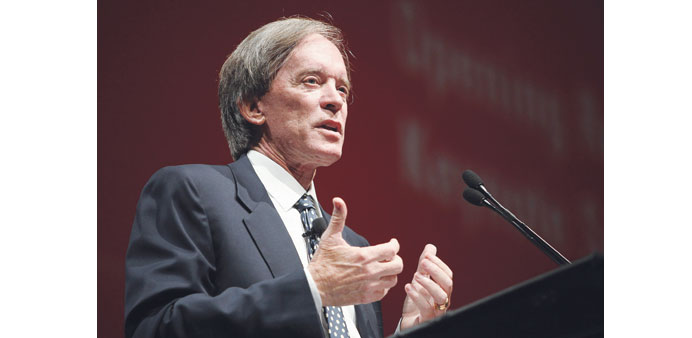
Gross is betting on an economic view he calls the ‘new neutral,’ which argues that the top speeds of the biggest economies and their equilibrium interest rates have declined and won’t return to levels seen before the financial crisis
Bloomberg
As Bill Gross vows to restore top performance at the world’s biggest bond fund, he’s taking a path many of his rivals shun.
Gross, who manages the $230bn Pimco Total Return Fund at Pacific Investment Management Co in Newport Beach, California, is betting five-year Treasuries, which are more sensitive to changes in the central bank rate than longer-dated bonds, will do well because markets overestimate how much the Federal Reserve will raise interest rates. Bond managers at Goldman Sachs Group Inc, BlackRock and JPMorgan Chase & Co say he’s wrong and the intermediate bonds he holds will suffer when the Fed lifts borrowing costs.
“Once they see the whites of the eyes of full employment, they will want to normalize rates at a faster clip,” Jonathan Beinner, co-head of global fixed income at Goldman Sachs Asset Management, said in a telephone interview.
Gross, 70, is betting on an economic view he calls the “new neutral,” which argues that the top speeds of the biggest economies and their equilibrium interest rates have declined and won’t return to levels seen before the financial crisis. While most bond managers agree rates will be lower, with the federal funds target ranging somewhere between 3% and 4% by 2018, Gross sees it at just 2%, making bonds attractive to Pimco that BlackRock and Goldman Sachs won’t touch.
As of April 30, his Pimco Total Return Fund had 94% of its money in bonds with maturities of 10 years and less, according to the firm’s website, with the biggest concentration, 38%, in bonds with maturities of three to five years.
Gross was betting against bonds with maturities of greater than 20 years.
If he’s right, the bond king could emerge triumphant and end his fund’s longest streak of redemptions. If he’s wrong, he could underperform peers for a third year in four.
“Believe me, by the end of 2014, Pimco’s going to be at the top, not close to the middle,” Gross said in a May 14 interview with Erik Schatzker and Olivia Sterns on Bloomberg Television’s “Market Makers.” He said he’s buying bonds maturing in five years to seven years.
Pimco’s new forecast, published in a report May 13, is the product of its annual Secular Forum, which guides the firm’s world view and investment philosophy over the next three to five years. In the aftermath of the 2008 financial crisis, that forum used the term “new normal” to describe an era of subdued returns, heightened government intervention and increasing clout for emerging nations in the global economy.
The heart of Pimco’s “New Neutral” message – that interest rates will not return to historically normal levels anytime soon - is broadly accepted. The predictions for the benchmark rate differ. Beinner at Goldman Sachs says it could be 3.5% to 4% by 2018. His counterparts at BlackRock and JPMorgan say 3% is probably a better bet.
“Rates will be lower than they have in the past,” Rick Rieder, chief investment officer for fundamental fixed income at BlackRock, the world’s largest money manager, said in a telephone interview. Rieder, who oversees $700bn, cited slower global growth, an aging population and subdued consumer spending as reasons to expect relatively low rates for an extended period.
Still, Rieder, 52, expects interest rates to rise as the US economy grows “at a pretty steady 3%,” barring problems in the housing market.
Robert Michele, who oversees $370bn as head of fixed income at JPMorgan Asset Management, is looking for US growth in the 3% to 3.5% range over the next few years.
An expansion of that pace, combined with some pickup in inflation, would allow the Fed to push up rates gradually to about 3%. The distinctions are big enough to drive very different investment choices. Gross argues that intermediate-term bonds reflect market expectations for Fed rates of as much as 4%, meaning they will do well once markets realize that the central bank has limited room to increase borrowing costs.
Longer-dated bonds offer less value after rallying the most this year, he says.
Treasuries maturing in five years have returned 2.05% this year through May 27, compared with gains of 5.9% for 10-year notes and 13% for 30-year bonds, Bank of America Merrill Lynch Index data show. Five-year note yields have dropped to 1.48% from 1.74% and 10-year yields are down to 2.44% from 3.03%. Yields on 30-year bonds dropped to 3.29% from 3.97% at the end of 2013. Most of the other bond managers say they like the 20- and 30-year bonds that Gross is avoiding, while steering clear of the intermediate bonds he recommends. They say that as the Fed starts to raise rates, short and intermediate rates will feel the brunt, while long-term rates will rise less.
“We do not like the five-year US Treasury,” John Bellows, a money manager at Western Asset Management Co, wrote in an e-mail. Western Asset, a division of Baltimore-based Legg Mason, manages $469bn in bonds.
“Holders of those maturities have become complacent about the potential for rising rates,” said Robert Michele. Longer-dated bonds in the 20-year to 30-year range are more attractive, he said, because pension funds, looking to avoid risk, are boosting demand for the securities.
BlackRock’s Rieder said he’s avoiding the “belly of the curve,” bonds with maturities of three to seven years, and agreed that “long Treasuries make some sense,” because of demand from institutional investors. Goldman’s Beinner said he is steering clear of bonds in the three- to five-year range because they will be hurt in the tightening cycle.
Beinner, who oversees $411bn in fixed-income investments, also is counting on a stronger US economy, driven by improvements in housing and corporate spending. The US expanded 1.9% in 2013, according to data compiled by Bloomberg.
“We are not going to have a boom, but we should do better than the anemic 2% growth levels we have seen,” he said.
There are bond managers more in sync with the “new neutral.” Franco Castagliuolo, who helps oversee $34bn in government and mortgage bonds at Boston-based Fidelity Investments, expects rates to rise very slowly.