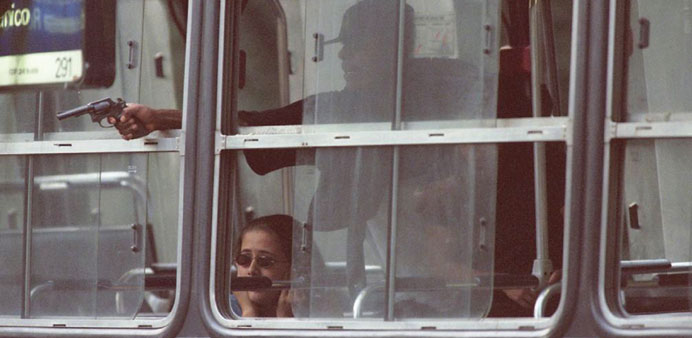
HIGH DRAMA: A still from the film that shows Nascimento pointing a gun at the police outside the bus.
By Anand Holla
When you happen to have incredible footage of a young and armed homeless man taking bus passengers hostage in a wealthy Rio de Janeiro neighbourhood, you wouldn’t be blamed if you settle for a racy, action documentary that exploits the high-octane drama of those four hours.
Directors Jose Padilha and Felipe Lacerda, however, were more ambitious than that. As much as it indulges in the hostage crisis, Bus 174 focuses on its tragic protagonist, Sandro do Nascimento, and goes the whole hog on this young fallout of a socially disparate Brazil.
Combining superb investigative journalism with remarkable sensitivity, Padilha and Lacerda piece together the cycle of poverty, desperation and violence by tracing Nascimento’s troubled past, talking to the hostages, policemen, and reporters involved in the episode, and using video shots of the incident taken for Brazilian TV.
As part of the Brazil Cinema Showcase, the Doha Film Institute screened Bus 174 at the Museum of Islamic Art Auditorium on Thursday evening.
It was on June 12, 2000, that Nascimento, armed with a pistol and high on drugs, made a failed attempt to rob a bus. Instead, he took the passengers hostage. As cops and reporters surrounded the bus, a SWAT team arrived, negotiating with Nascimento who threatened to kill the passengers if he wasn’t provided with ammunition in return for their release.
Meanwhile, throughout the four hours of madness, snipers snuck in vantage points, were prepared to shoot Nascimento if he acted on his threat. However, as one officer later admits to the camera, the police couldn’t have shot Nascimento as everything was on live TV and no family at home would like to see a gunk of splattered brain tissues on their screen.
Every once in a while, Padilha and Lacerda take us into the past so as to put the background of Nascimento and other “invisible people” like him, into a thought-provoking perspective. As a kid, Nascimento had witnessed the murder of his mother in a working-class neighbourhood. Traumatised, he took to street life, joining the many children who wander about in Rio’s slums, sniffing glue and mugging the rich.
Though Nascimento survived the infamous police massacre of street children sleeping outside a church in Rio’s Candelaria district in 1993, he never got over his friends’ murders. So much so that during the bus siege, he keeps reminding the officers about it.
Committing a spate of crimes in his adolescence meant that Nascimento would serve time in the city’s deplorable prisons – and even manage to flee. Yet, Nascimento wanted to put his life on track, or so we are told by an old woman who he had taken to be as his foster mother.
Perhaps the film’s most hard-hitting sequence is of the camera pushing its way into a crowded jail cell – Nascimento too was housed in one such hellhole – and hearing out the prisoners’ complaints of the inhuman conditions that they are living in.
The directors’ masterstroke is using the negative mode on the digital camera, which switches black with white, and makes the pleading prisoners seem like they belong to another scarily alien world. It’s a gritty, kick-in-the-gut scene.
By the time the film tumbles towards its inevitably ill-fated end, the directors have succeeded in telling us the unsettling reality of the other side of Rio. But almost nobody can manage to predict the climax.
Only in real life, could such a bizarre end to the episode be even believed. It all ends in an unexpected tragedy, first for one of the hostages and then for Nascimento.
As Nascimento decides to walk out of the bus holding a gun to a woman’s head, the editing is masterful. The all-important visual of the final showdown is explored from multiple angles, zooming into the point of action, or blurring out for impact.
Strangely, Nascimento doesn’t shoot the woman; a cop does. In a terrible accident, a cop who closes in on Nascimento, mistakenly fires the hostage on her face after which all three – Nascimento, the woman and the cop – collapse to the ground. We then learn that Nascimento hasn’t been shot at all, and in fact, he too has fired a shot at the woman.
As Nascimento is overpowered by a team of policemen, scores who witnessed the whole drama, rush in to dispense instant mob justice. To save Nascimento from people’s wrath, cops bundle him into the back of a van.
Unfortunately, too many cops jump into the van. When Nascimento is taken out of the van, he has died of asphyxiation.
It’s an end that fills you with outrage and shock, and raises a lot of questions – both being hallmarks of a powerful documentary film.