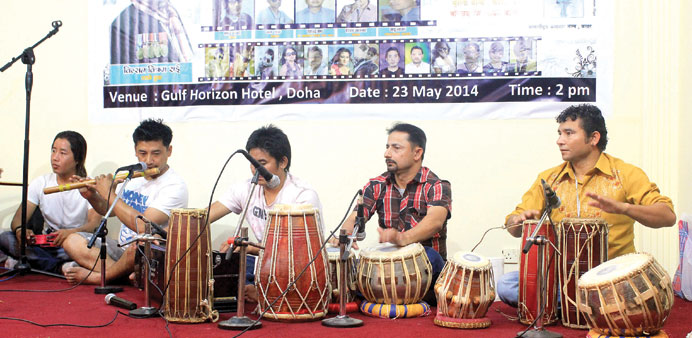
THE PERCUSSIONISTS: Babin Rai, Shyam Thapa, RK Lama, Bishnu Bhatta and Birendra Shrestha during one of their performances. Photo Usha Wagle Gautam
By Usha Wagle Gautam
The Nepali Artists Doha (NAD) organised a Lakha Ha New Year night recently. Popular Nepali comedian Wilson Bikram Rai was among the foremost attractions of the night.
The programme was different from most other programmes in that there wasn’t a chief guest nor any of the long and monotonous speeches that have become common at events like these.
The entire focus of the programme was entertainment, with a stand-up act, music and cultural dances. The core theme behind the programme, according to NAD, was to involve local expat artists and bolster their performances.
The programme started with a national song performed by Babin Rai, Shyam Thapa, RK Lama, Bishnu Bhatta and Birendra Shrestha.
Then the dancers came, moving impressively to the beats of Maruni, Bollywood and Tamang Selo.
Rai, the programme’s biggest attraction, performed his antics for two hours (with a short 10-minute break in between). Rai, also known as Takme Budha, is famous TV and silver screen comedian, actor and stage artist. For first one hour, he performed his Takme Budha (old man with the medal) role, which he has performed in many shows. This was the comedian’s second show in Qatar. He has performed over 50 shows in 30 different countries.
Shayam Thapa played dholak, an indigenous Nepali percussion instrument, during the show. Bishnu Bhattarai, another percussion artist, also played at the event. “After I landed in Doha in 2007, I thought I had forgotten how to play; however after two months of practice with NAD, I am back in form.”
Tabla player Babin Rain also performed at the event. “The tabla,” he said, “uses a complex fingertip and hand percussive technique played from the top, unlike the pakhawaj and mridangam, which mainly use the full palm and are played sideways. They are more limited in terms of sound complexity.”
Ram Kumar Rana Magar, madal player at the event, said his instrument is mainly used for keeping rhythm. Madal is the most widely used percussion in Nepal. The madal consists of a cylindrical body with a slight bulge at its centre, closed on both ends.
Birendra Shrestha played baasuri (flute) in the show. He said, “After I begin to play any note in baasuri, I forget all tensions and take pleasure in entertaining my listeners.”
Babin Rai, Janak Magar, Bhumika Rai and Kanchana Rai — four NAD artists — performed the Tamang Selo dance. Rai said the dance is performed to the rhythms of damphoo, an indigenous percussion instrument. Tamang Selo trust is also called the Damphoo Dance. The songs on while Tamang Selo is performed are based on day-to-day hardships of people, joys and sorrows. Damphoo is a small roundest drum where one side of the circular wood is covered by the skin of a goat which is joined with thirty two small bamboo pencil-like pieces.
Similarly, dancers Madhu Lama, Rekha Gurung, Bhumika Rai, Tek Bahadur BK and Janak Thapa Magar performed Purbeli Maruni, eastern ethnic Nepalese dance, in their cultural dresses. Bahadur said, “Maruni is performed during festivals, especially marriage, artists wear colourful dresses, shiny ornaments and nose rings and artists are accompanied by a clown called Dhatuwa (a liar).”
NAD awarded certificates and prizes for the best model, dancer, singer and lyricist judged by online voting. The winners — Ishwor Shahi, Mohan Shah, Sagar Chapagain, Saroj Pandey, Bishnu Basnet, Subash Gajurel and Dev Timilsina — were given their prizes by Wilson Bikram Rai.
NAD trains emerging dancers, singers and artists in one rented hall in Doha. NAD was established in 2007 and currently has 60 artists as its members.