


|
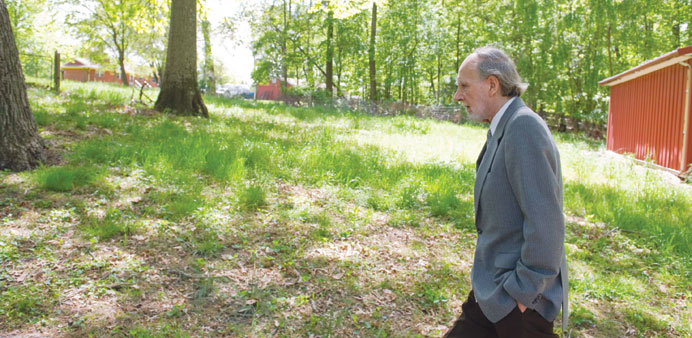
While scientists are engaged in an all-out, worldwide scramble to avert the energy and climate change crises, the biggest discoveries could come from a surprising quarter: a modest redwood home on a wooded, five-acre tract in rural Maryland, where a lone inventor toils day and night. |
Ronald Ace lacks hefty academic credentials or any of the billions of dollars that have flowed to other researchers. That hasn’t diminished his zeal in a years-long campaign to accomplish what many scientists deem unattainable.
If the 73-year-old inventor is right, he is on the brink of two historic breakthroughs.
If his novel ideas are validated and take hold, they could change the world.
Those are big ifs.
Ace has applied for patents for two inventions that he believes could speed a dramatic transition to cheap and abundant clean energy, shrink oil consumption to a gurgle and reduce greenhouse gas emissions to a smidgen of today’s levels.
His “Solar Trap”, first reported in May 2013, has gained some credence from a former solar engineer at the Sandia National Laboratories in Albuquerque, New Mexico, who did a confidential review and found “no apparent deficiencies”.
Ace calls his flat-panel trap “a fundamental scientific and environmental discovery” and contends that it could collect sunlight at high-enough temperatures to shatter the barriers to a solar age.
The device can capture more than 90% of the rays that hit it, as much as 10 times more than sun-tracking photovoltaic panels being installed around the globe, he says.
More recently, Ace has filed a second patent application, for an invention that he touts as likely able to transform heat into electricity with nearly 100% efficiency, 20-fold that of comparable devices in the clean-as-you-can-get field of thermoelectrics.
His claim is especially astounding, because it seems to defy the second law of thermodynamics, a pillar of physics that emanated from the work of French scientist Nicolas Leonard Sadi Carnot 190 years ago.
But Carnot’s equation dictating heat loss in steam engines has long been interpreted too broadly and doesn’t apply to this device, says Ace, who as a young man worked for more than a decade in the University of Maryland’s molecular physics laboratory.
Andrew Masters, who has spent over 20 years as a US thermoelectrics industry engineer, has come to the same conclusion after confidentially reviewing Ace’s patent application and Carnot’s work. Masters, who has built prototypes for world-renowned research institutions, says he “couldn’t find a flaw” in Ace’s concept.
In a letter to Ace last month, Masters said he’s seen hundreds of proposals to harness the waste heat in thermoelectric devices but never one so “conceptually simple and yet potentially game changing”.
Another review came from John Darnell, a recently-retired congressional energy adviser who privately analysed both inventions and concluded, before becoming critically ill, that each would far surpass today’s technology.
Ace’s problem is that neither of his inventions has been validated in customary ways, such as in published, peer-reviewed papers or by constructing prototypes, for which he needs financing.
The costly patent applications, filed in 148 countries, are still secret and will remain so for nine months or more. So despite his rare blend of expertise in physics, optics and thermal energy, Ace’s expansive claims are sure to draw scepticism, if not disbelief, from the scientific community.
To grasp the dimensions of what Ace is proposing, consider this:
If the thermoelectric invention works as he hopes, it could offer a way to build affordable electric cars that don’t require recharging and can travel up to 300 miles on two gallons of gas.
If both ideas were to perform as envisioned, the devices could be combined to create power plants that have no moving parts, emit no greenhouse gases, deliver electricity for no more than a third of today’s cost and do so reliably with more than 90% efficiency - a feat heretofore considered beyond reach.
Ace’s chances of success hinge not only on the validity of his scientific conclusions, but also on whether investors, governments, institutions or potential patent licensees put money behind his tiny company, Pinnacle Products, which promotes his energy-saving ideas on the website H2OPE.US.
He hopes that the comments from expert reviewers will help attract financing. Ace has retained Nathan Siegel, the former Sandia solar engineer who is now an assistant professor of mechanical engineering at Bucknell University, to analyse whether his Solar Trap could overcome the obstacles that for decades have stunted progress in solar energy.
A central issue is long-term energy storage, so that solar plants can reliably provide power at night and during long bouts of cloudy weather.
Battery storage for photovoltaic panels, which directly convert solar energy to electricity, is expensive and generally measured in hours, not days.
Storing solar thermal energy has also been a problem, because scientists haven’t found a way to operate a solar power plant cost-effectively at temperatures above roughly 900 degrees Fahrenheit. Higher temperatures are needed to ensure that enough energy can be stored in cheap materials, such as sand, to fuel a plant when there’s no sunlight.
Siegel says that in 10 years in the solar field he has never encountered an approach like Ace’s trap, designed to concentrate energy at 2,400 degrees Fahrenheit and higher for affordable long-term storage.
Known as “angular selectivity”, the design capitalises on largely unnoticed properties of sunlight: it arrives in almost perfectly parallel rays, but when heated, radiates at angles spanning 180 degrees, Ace says.
Precisely how the invention works will remain secret until a patent is published. But Ace says he designed it to geometrically ensnare solar rays to prevent diffuse radiation and conduction losses as temperatures hit extremes - a vexing problem for the solar industry.
“In my opinion, this approach is unique” and worthy of more comprehensive analysis, Siegel points out, noting that the device has the potential to collect solar energy at soaring temperatures without a hugely expensive field of thousands of mirrors like those that concentrate sunlight in today’s solar plants.
Siegel has not extensively analysed Ace’s lower-temperature, rooftop Solar Trap, designed to power homes and businesses by collecting energy at up to 1,000 degrees Fahrenheit, hot enough to meet much of the world’s energy needs. However, he says Ace’s predictions that it could perform at greater than 90% efficiency “are likely accurate”.
Former Republican Representative Roscoe Bartlett of Maryland, who quietly championed Ace’s efforts until losing his seat in Congress in 2012, says he suspects some investors have baulked because Ace is “somewhat eccentric, and what he’s proposing seems too good to be true”, perhaps prompting them to dismiss him as “loony”.
But Bartlett, a scientist himself, calls Ace a “national treasure”.
Ace says he’s now inviting potential investors to support his work by financing consumer devices he’s invented, fearing that his high-tech energy solutions and planetary-scale talk might frighten people.
“America doesn’t have an energy solution,” Ace said. “The world doesn’t have an energy solution yet. That’s my dream. It has always been my dream, but I scare people because I think too big. Somebody has to. We can’t get there from here thinking small.”