


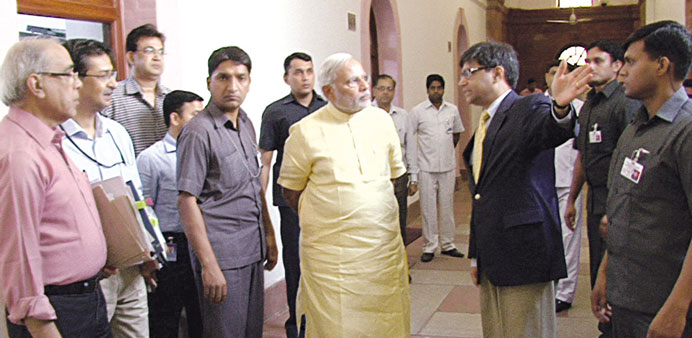
Prime Minister Narendra Modi speaks to officials of the Prime Minister’s Office in New Delhi yesterday.
Prime Minister Narendra Modi invited Chinese President Xi Jinping to visit India later this year as the Bharatiya Janata Party leader extended another olive branch yesterday to one of New Delhi’s traditional rivals.
The invitation was made during a phone call between the newly-elected Modi and his Chinese counterpart Li Keqiang in which both premiers expressed a desire for stronger ties, India’s foreign ministry said.
Their conversation came only two days after Modi held landmark talks with Pakistan Prime Minister Nawaz Sharif.
“Prime Minister Modi extended through Premier Li an invitation to President Xi Jinping to pay a visit to India later this year,” said an external affairs ministry statement.
Li conveyed the “Chinese government’s desire to establish robust partnership with the new government of India for further development of relations between the two nations,” the statement added.
Modi said he wanted to work closer with the Chinese government to deal with any “outstanding issues in our bilateral relations” and “welcomed greater economic engagement between the two countries.”
The last visit from a Chinese head of state to India was made by Xi’s predecessor Hu Jintao in 2012 when Manmohan Singh was the prime minister.
Modi took office on Monday after winning a landslide election victory that swept the Congress Party from power after 10 years of rule.
While there is heavy trade between India and China, relations are still dogged by mutual suspicion - a legacy of a brief, bloody border war in 1962 over the northeastern state of Arunachal Pradesh that is nestled in the eastern stretch of the Himalayas that China claims as its own.
In February, Modi had warned China to shed its “expansionist mindset” at an election rally in Arunachal Pradesh.
China hit back at Modi’s remarks, saying it had “never waged a war of aggression to occupy any inch of land of other countries.”
Relations between the two countries also took a hit in April last year when India accused Chinese troops of intruding deep into its territory in another remote region of the Himalayas, sparking a three-week stand-off that was only resolved when troops from both sides pulled back.
The countries have held a series of talks to try to resolve their border dispute but the frontier still bristles with tension.
At an annual defence and security dialogue in New Delhi earlier this year, the two countries had agreed to hold a high-level military meeting in India to discuss management of border issues.
The talks had also decided that their next joint army exercise would be in India in 2014 after a “successful” one in China last year.
India runs a $40bn bilateral trade deficit with China, and Modi is expected to seek greater market access to reduce that gap. China’s own embrace of an export-led model has helped its economy outgrow India’s fourfold since 1980.
China has been embroiled in a series of territorial and other disputes with its neighbours over the years, including Vietnam, which on occasion have led to armed conflict.
Beijing is also involved in multiple other disputes in the South China Sea, and has a bitter row with Japan over islands in the East China Sea.
Despite his reputation as a hardline nationalist, Modi invited Sharif to his inauguration ceremony on Monday in New Delhi, along with the leaders of several other neighbouring countries.
PM retains Varanasi seat, gives up Vadodara
Prime Minister Narendra Modi yesterday said he had given up his Vadodara Lok Sabha seat in Gujarat and retained the Varanasi seat in Uttar Pradesh.
“I will represent Varanasi in (the) Lok Sabha and I look forward to this wonderful opportunity to serve Ganga Maa and work for Varanasi’s development,” Modi said in a series of tweets.
“I assure (the) people of Vadodara I will leave no stone unturned in ensuring that Vadodara’s development scales newer heights in the years to come.”
In another tweet, the former Gujarat chief minister said: “Resigned from Vadodara LS seat. Due to people’s affection, got elected by historic margin. Will always remain grateful to people of Vadodara.”
Meanwhile Modi has asked ministers and officials to come up with a plan of action for the first 100 days.
Modi’s Bharatiya Janata Party recently stormed to power on promises of reviving the economy and fighting corruption.
He “directed the ministers to sit with officials and set out their priorities, programmes and timetable for the first 100 days,” Parliamentary Affairs Minister M Venkaiah Naidu told reporters.
He said Modi also asked cabinet ministers to take their ministers of states into confidence and give them adequate work.
“The prime minister said that the main issue was governance. That is the need of the hour and there is need to focus on it. He said delivery and efficiency is important and there was also need to pay attention to implementation (of government schemes),” Naidu said.
He said Modi told the ministers that there should be immediate response to representations from states.
“State proposals should not be kept pending for long. There is need to take states along,” he said.
“The issues raised by MPs and by the people should also be viewed in all seriousness and resolved soon,” Naidu added.
Modi, who served as Gujarat chief minister for over 12 years, had often complained about the indifference of the central government to some issues raised by his state.
Naidu said Modi was keen that the “spirit of federalism was followed.”
“He (Modi) asked them (ministers) to prepare a time table for the first 100 days and decide on priorities,” Naidu said.
He said departments had been asked to prepare a list of issues that were pending and to try and implement them.
Naidu said Modi will meet ministers and secretaries of various departments in the coming days.
Asked about the timeframe for the ministers to prepare an action plan for 100 days, Naidu said the prime minister had given his guidance and everyone knows the “mind of the prime minister.”
He also set 10 priorities, including removing hurdles to economic growth; prioritising education, energy and water; reforming the infrastructure sector, and providing a people-oriented government and governance, NDTV network reported, citing unnamed officials.
Other priorities included improving the workings of government and bureaucracy, the report said. Naidu declined to confirm the priority list.
The first session of the newly elected Lok Sabha, the lower house of parliament, will be held from June 4 to 11 with the first two days being used to swear in the new lawmakers, Naidu said.
The speaker of the house will be elected on June 6 and President Pranab Mukherjee will address a joint session of both houses of the parliament on June 9, Naidu said.
*Prakash Javadekar yesterday took charge as the minister of environment, forest and climate change and said an online submission system for time-bound clearance of applications and greater transparency has been launched.
Javadekar said the system would ensure greater transparency and time-bound and faster clearance of applications.