


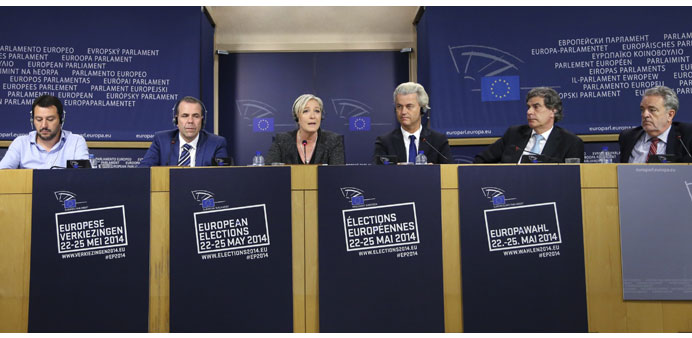
Italy’s Northern League party member Matteo Salvini (left), Austria’s far-right Freedom Party (FPOe) member Harald Vilimsky, Le Pen, Dutch far-right Freedom Party (PVV) leader Wilders (third right), PVV member Marcel de Graaff and Belgium’s Flemish right-wing Vlaams Belang party member Gerolf Annemans (right) address a joint news conference at the European Parliament in Brussels.
DPA/AFP/Brussels
Fresh from her shock victory in European elections on home turf, French far-right chief Marine Le Pen has launched a strong bid for leadership of the eurosceptic camp in Brussels.
Le Pen’s National Front (FN) joined forces with four other European parties yesterday in a bid to create a new right-wing alliance tasked with hampering the European Union’s encroachment on national policies.
“We will try to prevent any new advances by the EU, we will try to block with our votes any new advances to the detriment of populations,” Le Pen said at the European Parliament in Brussels.
Anti-establishment parties are jostling for influence in the legislature after making gains in European elections last week.
Le Pen stunned mainstream French parties by coming in first with 26% of the vote.
There are concerns that eurosceptic and far-right parties could try to create havoc in EU affairs by vetoing legislation in the parliament or hampering reforms.
But that would require them to form alliances against pro-EU groups, which will still hold the vast majority of seats in the new parliament.
The legislature will take up its work on July 1. Forming a parliamentary group requires at least 25 deputies from seven countries.
Officials from the Netherlands’ Party for Freedom (PVV), Italy’s Northern League, Austria’s Freedom Party (FPOe), and Belgium’s Vlaams Belang confirmed at the Brussels press conference that they are ready to work with Le Pen’s National Front.
The five parties would control a combined 38 parliamentarians, according to Le Pen.
She said she has no doubt that two more parties can be recruited, but declined to give any details on who she is negotiating with.
Eurosceptic parties have been wary of aligning with the far-right.
Le Pen said she has no intention of working with extreme far-right groups such as Greece’s Golden Dawn and Hungary’s Jobbik.
Despite the uncertainty surrounding its other partners, the right-wing group is already “writing history”, PVV leader Geert Wilders argued.
“It is a group of parties that fight for sovereignty, for the nation state, for national sovereignty and against the parties of the europhiles that are so over-represented in Europe today,” he said.
“This idea of a European super-state is something we want to wipe off the map,” Gerolf Annemans of Vlaams Belang added.
But FPOe secretary-general Harald Vilimsky also dismissed as “absurdities” charges that the far-right wants to “destroy Europe”, saying that it is in favour of “a Europe of free and sovereign nations”.
Northern League leader Matteo Salvini also pointed to problems with immigration and the need to fight “Islamic extremism”.
“Some people are a bit worried about this alliance,” he added. “I think that’s a good thing.”
The Northern League had so far been a part of the Europe of Freedom and Democracy Group in the EU parliament, which is led by British eurosceptic Nigel Farage.
Farage met yesterday with Italian protest party leader Beppe Grillo for talks about a possible alliance, reports said.
Italy’s SkyTG24 news channel, quoting unnamed sources, said Grillo was scheduled to meet Farage, whose United Kingdom Independence Party (UKIP) trounced mainstream parties in Britain’s European elections.
Grillo’s 5-Star Movement (M5S) is one of the up and coming eurosceptic forces in Europe.
It performed less well than expected in Italy’s European elections, but still took 21% of the votes and 17 seats.
As an official group, Le Pen’s National Front and its allies would win the right to express an opinion on any issue raised in plenary session and take the presidency of any of the parliament’s 20 committees and two sub-committees.
Its president would help draw up the agenda of the plenary sessions and win the right to reply directly in plenary session to the heads of the European Commission and the European Council.
It would also be given a secretariat, offices and aides paid by Parliament.
Last year the Parliament’s seven outgoing political groups shared a budget of 57mn euros ($78mn).
On top of this, the group would benefit from extra subsidies paid out to pan-European parties such as the 400,000 euros ($545,000) a year currently handed to the Malta-based European Alliance for Freedom (EAF).
Depending on how many members of parliament (MEPs) it had, it could win anywhere between 1mn and 3mn euros a year.
“An alliance of far-right parties would be more a marriage of convenience than a marriage of love,” said a Parliament official speaking on condition of anonymity.