


Reuters
New Delhi
|
|
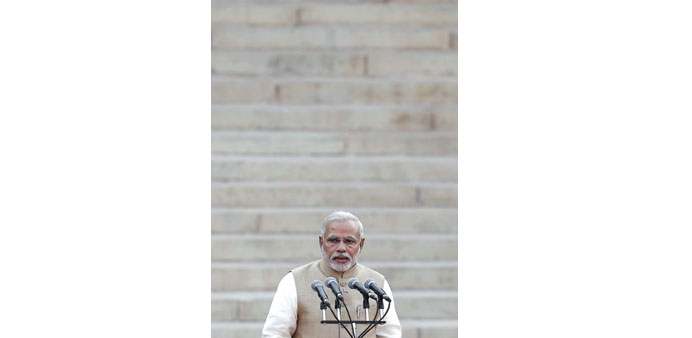
Narendra Modi was sworn in as India’s prime minister in an elaborate ceremony at New Delhi’s presidential palace yesterday, after a sweeping election victory that ended two terms of rule by the Nehru-Gandhi dynasty.
The low-caste son of a tea stall-owner, Modi, 63, won India’s first parliamentary majority after 25 years of coalition governments, giving him ample room to advance economic reforms that started over two decades ago but stalled in recent years.
Many supporters see him as India’s answer to the former US president Ronald Reagan or British leader Margaret Thatcher. One foreign editor has ventured Modi could turn out to be “India’s Deng Xiaoping”, the leader who set China on its path of spectacular economic growth.
Modi said the election had delivered a mandate for “development, good governance and stability”.
“Together we will script a glorious future for India. Let us together dream of a strong, developed and inclusive India that actively engages with the global community to strengthen the cause of world peace and development,” he said in a statement.
Modi invited leaders from across South Asia to his swearing-in ceremony, including Prime Minister Nawaz Sharif from Pakistan, an unprecedented gesture.
Even before his inauguration, Modi had some recognition abroad, treated by many with suspicion, for Hindu-Muslim violence that erupted 12 years ago in Gujarat, the western state he ruled.
The US administration denied Modi a visa in 2005, but President Barack Obama has now invited him to the White House.
He has spoken with the presidents of the US and Russia and he has become one of only three people that Japanese Prime Minister Shinzo Abe follows on Twitter.
The pomp unfolded as the summer evening closed in at Rashtrapati Bhavan, a colonial-era sandstone mansion with 340 rooms in the heart of New Delhi.
Looking on were some 4,000 guests, ranging from members of the defeated Nehru-Gandhi family to top industrialists, Bollywood actors and the leaders of several neighbouring countries.
Supporters exploded fireworks in celebration a few blocks away at the headquarters of his Bharatiya Janata Party (BJP) after he was sworn in.
Modi kicked things off on Sunday with an announcement that he would streamline the cabinet and move to a more centralised system of governing aimed at breaking decision-making bottlenecks widely blamed for dragging down economic growth.
Modi said he would appoint ‘super ministers’ in charge of several departments but by late yesterday had not revealed the portfolios for the cabinet.