


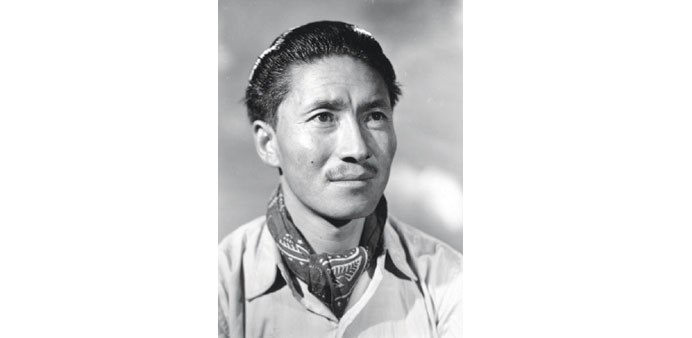
By Pratibha Tuladhar/DPA
No one knows the exact birthdate of Tenzing Norgay Sherpa, one of the first two men to reach the summit of Mount Everest, only that it was a hundred years ago.
“People in those days did not have a way of recording birthdays. His mother only remembers that Tenzing was born in late spring in 1914, the year of the hare,” explains Tashi Tenzing Sherpa, a grandson of the legendary mountaineer.
“We just had the 28th death anniversary observation for my grandfather, on May 9,” says Tashi.
“Tenzing liked to say May 29th was his birthday - the day he climbed Everest,” Tashi smiles.
The family plans to unveil a statue of Tenzing and Sir Edmund Hillary on that day at Namche Bazaar of Solukhumbu district, in the shadow of the world’s highest mountain.
The first given name of Tenzing, who was born in a small village called Moyey in Tibet, was Namgyal Wangdi, says Tashi, who authored the book Tenzing and the Sherpas of Everest.
“He was ill frequently as a child. It was the head lama of the Thangboche Monastery who named him Tenzing Norgay after a wealthy Sherpa who had died in Solukhumbu. With that the boy’s fortunes and health improved.”
Only six of Tenzing’s 14 siblings survived. At the age of eight, he and his family crossed the Nagpala pass and moved down to Solukhumbu in Nepal. But the family’s new home, where only potatoes could grow, offered little respite from drudgery.
“Tenzing once said: ‘In a way, Tibet is home of my spirit but as a living man, I never lived there. Mountains are my home, but one does not build his home on a peak.’ So, yes, Solukhumbu was his real home, even though he spent much of his later life in Darjeeling.”
At 19, Tenzing and his young wife Dawa Phuti walked for a month to reach Darjeeling, India, where he heard pottering work was available. It was after several odd jobs that the tall, charismatic Sherpa caught the eye of Eric Shipton, who was preparing to launch an Everest expedition from the northern face of the mountain in China.
Small teams from the expedition tried six times to reach the summit. On the seventh, Norgay and New Zealander Hillary were given their chance, and successfully climbed to the highest point on earth.
“He (Tenzing) did inspire me to great extent,” says Apa Sherpa, the record Everest summiteer. “He is the first Sherpa to introduce Nepal to the world and I wanted to follow in footsteps and introduce Nepal to the world stage also.”
Apa, who has climbed Everest 14 times, is also a relative of the
legendary mountaineer.
“In school we were taught about the world heroes: the king of soccer, Pele, and tiger of the snow, Tenzing,” says Temba Tseri Sherpa, who became the youngest
mountaineer on Everest in 2001.
“We used to sing the song dedicated to him: ‘Our Tenzing Sherpa climbed the Himalayan peak, sound the tambourine with pride.’ Because I’m a Sherpa myself, I wanted to be like him. It seemed possible,” says Temba, who lost his fingers to frostbite.
The government of Nepal gives out the Tenzing-Hillary Mountaineering Award each year on May 29.
“Tenzing is the man who introduced Nepal to the world by stepping on Everest for the first time. The award that we give out in his name speaks of how much we value his contribution to mountaineering,” said Madhusudan Burlakoti, joint secretary of the tourism
ministry.
Authorities also named an unclimbed 7,916m peak after Tenzing this month and declared it open to mountaineers.
But Tenzing’s family says the government did little for him while he was alive.
“My grandfather moved to Darjeeling because the king did nothing for the family. India had done a lot to help us,” says Tashi. “It’s the same with Apa Sherpa and other great mountaineers. The government seems to forget the country’s heroes.”
Tashi’s mother Pem Pem was Tenzing’s favourite child and his travelling companion.
“I used to see him come over to visit my mum all the time and I was always fascinated by this man. He was one of my heroes. He was so humble. Here’s a man who can’t read or write and came from a very poor background but he loved what he loved doing and was
dedicated to it.”
Tashi says Tenzing taught him to do his best in life. The family has been involved in development work in Solukhumbu, work they consider the patriarch’s legacy.
“We’re not just climbing, we’re putting our energy into healing the place and trying to help people,” he says.
“You’d be very impressed if you met my grandpa. He was a very jolly man, not someone who just carried a load but did it with ambition. Even as a coolie, he was neatly dressed and always used a handkerchief to wipe his nose. And there was his incredibly charismatic simile, of course. That’s how he got noticed by Shipton.”
And like Sir Edmund Hillary said, he was always willing to be the first to go.