


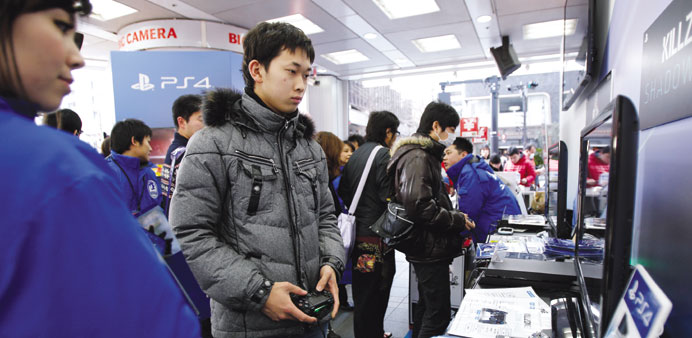
A customer plays a video game on a Sony PlayStation 4 console at an electronics store in Tokyo. The Japanese firm agreed to form two ventures to start making and selling PlayStation consoles after China lifted a 13-year ban on sales of the machines.
Sony Corp took steps towards selling PlayStation gaming consoles in China as chief executive officer Kazuo Hirai seeks to tap players in the world’s largest market and rebound from a projected sixth loss in seven years.
Sony agreed to form two ventures with Shanghai Oriental Pearl (Group) Co, owner of the Oriental Pearl Tower, to start making and selling PlayStation consoles after China lifted a 13-year ban on sales of the machines. The Tokyo-based company will have a 70% stake in one venture and 49% in the other, according to a statement filed with the Shanghai Stock Exchange. Sony rose the most in almost two months.
The move by Sony comes after Microsoft Corp announced plans to sell its Xbox One machine in China, and Nintendo Co said it plans to expand in emerging markets with new devices. China’s video-game industry will generate about $10bn in sales next year, according to PricewaterhouseCoopers, and console makers are trying to distract Chinese players from games on their smartphones and tablet computers. “PlayStation needs to expand its user base,” Hirai told reporters in Tokyo today after the ventures were announced. He added that the PlayStation platform is the main driver for expanding the company’s network business, which includes music and video downloads.
Sony rose 3.1% to close at ¥1,683 in Tokyo trading. The shares are down 7.8% this year, compared with the 8.3% drop on the benchmark Topix index.
In September, Shanghai inaugurated a free-trade zone with more relaxed financial and investment controls as China seeks to unleash market forces in the world’s second-largest economy. That’s helping attract companies from console makers to banks.
Nomura Holdings Inc, Japan’s biggest brokerage, signed an agreement earlier this month with Shanghai Lujiazui Financial Holdings and others to form a venture in the free-trade zone.
“Sony entering the China can broaden sales,” Ryosuke Katsura, a Tokyo-based analyst at UBS AG, said by phone. “PlayStation 4’s online game network service can help the company avoid piracy issues that are more prevalent with packaged games.” Satoshi Fukuoka, a spokesman for Sony, declined to comment on whether Sony will sell the PS4 or design another console for China, and he also declined to comment on the timing for starting sales in China.
State-owned Shanghai Oriental is involved in hotels, cable television, advertising and broadcasting on Shanghai’s subway system. The company can help Sony navigate the regulatory process for getting licenses, said Xu Xiaojun, the board secretary of Shanghai Oriental Pearl Group.
The company is building its game business portfolio and recently bought stakes in US and Japanese companies, she said.
“This is a big market,” Xu said. “We want to build a big culture and entertainment platform where we can utilise our traditional advantages in entertainment content.” Japan’s No. 1 TV maker unexpectedly forecast a ¥50bn net loss this year as slumping demand for its sets and video cameras was compounded by the costs of restructuring and exiting the personal-computer business.