


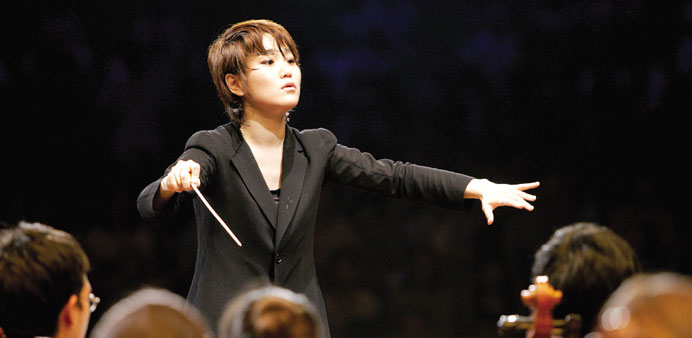
IN HARMONY: QPO director Han-Na Chang leads the orchestra.
Reliving the memories of some musical greats of the yesteryears, renowned music director Han-Na Chang enthralled the Doha audience at Katara Opera Theatre. By Umer Nangiana
Arranging ‘musical colours’, stealing them from different instruments with her baton, in a melodious flow, she indeed painted great pictures in the air.
Reliving the memories of some musical greats of the yesteryears and reviving their tradition of tributes, renowned music director and conductor Han-Na Chang enthralled Doha audience at Katara Opera Theatre on Saturday night with her orchestral excellence.
Taking idea from the similar performance in the past by music directors performing ‘pictures from an exhibition’, Chang directed a full orchestra with exuberance before a packed house.
Taking her podium facing the ensemble of musicians, she was as eloquent in her wavy movements as she was expressive in the arrangement of music. It was breathtakingly harmonious.
Chang performed Edvard Grieg’s Peer Gynt suite No1 and No2 besides recreating Modest Mussorgsky’s Pictures at an Exhibition in many-a-time tried and tested arrangement by music director Maurice Ravel, first performed in 1922.
In 1874, Russian composer Mussorgsky had composed Pictures at an Exhibition for piano in 10 movements (plus a recurring, varied Promenade). The suite is Mussorgsky’s most famous piano composition that became a showpiece for virtuosco pianists and later inspired various orchestrations and arrangements produced by other musicians and composers.
For those who did not know the context of Pictures at an Exhibition, the musical in itself was a treat but the ones knowing how Mussorgsky had composed the music for his friend, painter and architect Viktor Hartmann’s exhibition, after the latter’s death in 1873, it was a pure delight.
It is said that Mussorgsky, saddened by the death of Hartmann, had composed Pictures at an Exhibition in six weeks. The music depicts an imaginary tour of an art collection. Titles of individual movements allude to works by Hartmann.
Chang led the Qatar Philharmonic Orchestra (QPO) with the same fire at Katara. While the first session with Edvard Grieg’s Peer Gynte set the tone, Mussorgsky’s composition took it to epic heights in the final session.
More than a minute long applause from the house was just a partial depiction of how rich was the musical experience. Mussorgsky based his musical material on drawings and water colours by Hartmann produced mostly during the painter’s travels abroad. Locales include Poland, France and Italy; the final movement depicts an architectural design for the capital city of Ukraine.
Although he was a brilliant composer, Mussorgsky’s biggest problem was loneliness which drove him to alcohol. This greatly affected his health, landed him in hospital and caused his eventual death.
Mussorgsky died before he could finish his opera Khovanshchina but it was completed by his friend and former flat mate Nikolay Rimsky-Korsakov. For many years, Mussorgsky’s works were mainly known in versions revised or completed by other composers.
Mussorgsky links the suite’s movements in a way that depicts the viewer’s own progress through the exhibition. Two Promenade movements stand as portals to the suite’s main sections.
In September 2013, Han-Na Chang became music director of the QPO as well as Principal Guest Conductor of the Trondheim Symfoniorkester, both appointments immediately following her debut appearances with the orchestras.
A passionate advocate for the importance of classical music in modern community, Chang founded the annual Absolute Classic Festival in Korea in 2009 where she serves as the Aristic Director.
Han-Na Chang first gained international recognition for her precocious musical talents at the age of 11 when she won both the First Prize and Contemporary Music Prize at the Fifth Rostropovich International Cello Competition in Paris in 1994.
Since then, she has collaborated with Berliner Philharmoniker, New York Philharmonic, Los Angeles Philharmonic, The Philadelphia and Cleveland Orchestras, London, Chicago, San Francisco, Montreal, Pittsburgh and Boston symphony orchestras besides many others around the world.
BELOW:
MUSICAL COLOURS: Facing the ensemble of musicians, director Han-Na Chang brought back some of the classic compositions to the audience at Katara Opera Theatre.