


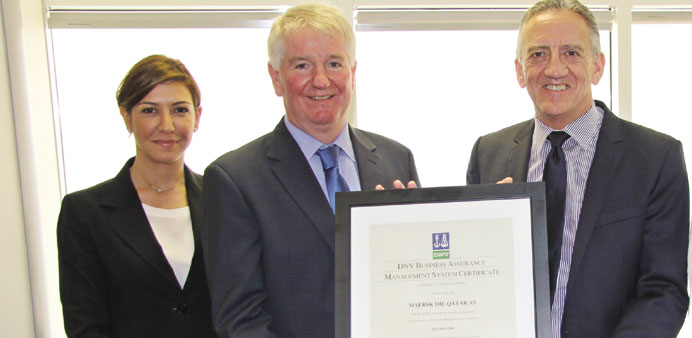
Maersk Oil Qatar officials pose after receiving the ISO re-certification.
Maersk Oil Qatar’s (MOQ) Environmental Management System (EMS) has been re-certified to the International Standards Organisation (ISO) 14001:2004 standards.
The ISO 14001:2004 certification is a globally accepted standard for EMS, indicating that MOQ – operator of Qatar’s largest offshore oil field, Al Shaheen – has identified the environmental aspects of its operations, adheres to regulatory requirements and takes a systematic approach to continuously improving its performance.
“Maersk Oil places the utmost importance on environmental responsibility and we are committed to conducting our operations responsibly and in compliance with the laws of Qatar, and in line with accepted international regulations and standards. We regularly review our operational and production process to ensure all environmental controls are robust and monitored across the Al Shaheen field,” MOQ managing director Lewis Affleck said.
According to the ISO, a worldwide federation of national standards bodies, the ISO 14001:2004 certification enables an organisation to identify and control the environmental impact of its activities, continually improve its environmental performance and implement a systematic approach to setting environmental objectives and targets.
“Maersk Oil Qatar’s ISO 14001:2004 accreditation underscores our commitment to fulfil our environmental responsibility. While conducting an audit of this scale is intensive, it is a highly important process,” according to Andy Pearce, head of health, safety, environment and quality at MOQ.
The EMS allows the company to manage and minimise environmental impacts through a process of setting objectives and targets to continually improve performance, and meet environmental laws and regulation. It also plays an important role in supporting emission reductions, minimising discharges to the marine environment and using resources efficiently, he added.
Together with Qatar Petroleum, Maersk Oil has successfully reduced gas flaring from the Al Shaheen field to an absolute minimum; a rare accomplishment in the industry. A 90% reduction in flaring was achieved in 2007-13 by capturing previously flared gas and transferring it onshore for power generation, thereby increasing the national electricity supply, providing employment and transferring technical knowledge to local industry.
As a result of its approach to environmental management, the project’s gas gathering system was recognised as the world’s largest Clean Development Mechanism project by the UN Framework Convention on Climate Change, as part of the Kyoto Protocol.