


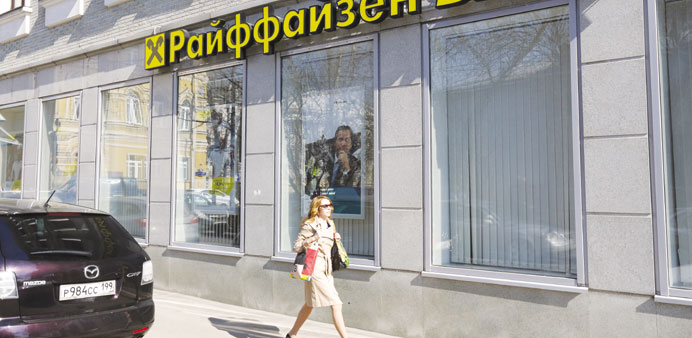
A pedestrian passes a Raiffeisen Bank International branch in Moscow. Raiffeisen Bank and Nokian Renkaat are facing a turning point in their market fortunes as investors bet the “Russian proxy” label will stick for some time to come.
Russia, which once promised rich pickings for European firms highly exposed to the country, now looks more like a liability for them as the economy struggles and investors worry the Ukraine crisis is set to fester.
The toppling of Ukraine’s pro-Russian president in February has triggered the biggest row between Russia and the West since the Cold War, leading to sanctions on some Russian individuals and companies and a knock to Russia’s economic growth prospects.
The crisis has also heightened investors’ sensitivity to geopolitical risk and Ukraine’s planned presidential elections on Sunday provide the latest prompt to shareholders to reconsider their exposure.
Companies such as Nokian Renkaat and Raiffeisen Bank are facing a turning point in their stock-market fortunes as investors bet the “Russian proxy” label will stick for some time to come - even if the companies themselves are stepping up efforts to change their business tactics.
“The bottom line is the risk premium for these companies (significant exposure to Russia) has increased, not just because of the political situation but also because the Russian economy is worsening,” Jorge de Mariscal, chief investment officer for emerging markets at UBS Wealth, said. “That’s going to impact profits and revenues of companies exposed to it.”
German retailer Metro AG postponed the launch of a partial initial public offering of its cash and carry business, while Coca-Cola HBC, the world’s No 2 bottler of Coca-Cola drinks, has started cutting costs.
The two companies generate about one-fourth of their revenues from Russia.
Finnish tyre maker Nokian Renkaat, which makes about a third of its sales in Russia and runs a large factory there, has postponed expansion of the plant due to the geopolitical crisis.
Although most of the Western European firms contacted by Reuters maintained business was normal, investors have punished stocks of the firms heavily exposed to the region.
Shares in companies such Nokian and Coca-Cola HBC have fallen 10 to 15% since the start of the Ukraine crisis after spiking 15 to 20% in the previous eight months.
Analysts said the decline is likely to gather momentum as Russia faces the risk of further economic sanctions.
“From a top-down point of view, Russia-exposed companies have the risk of being treated as a proxy for domestic stocks in the event of hard economic sanctions against Russia,” Christian Stocker, equity strategist at UniCredit in Munich, said. Russia is accused of fomenting pro-Russian sentiment in Ukraine, which has already lost Crimea after it was annexed by Moscow.
The US and EU have threatened to ramp up sanctions on Moscow if it interferes in the Ukrainian vote.
As a consequence, a subsidiary of Raiffeisen Bank said last month it would close all its branches in Crimea, while around a dozen chief executives and chairmen of major US and European Corps pulled out of the St. Petersburg International Economic Forum from May 22-24.
Eduard Zehetner, chief executive officer of Austrian property group Immofinanz, told Reuters the current political situation was “certainly not encouraging” for attracting foreign investors to Russia.
“This is also reflected in some retailers’ expansion plans (sitting-on-the-fence-approach for the moment). But things can change quickly and retailers are not moving out as consequence of the political tensions.”
Analysts said a slowing Russian economy would prompt Russia-exposed companies to refocus on other regions.