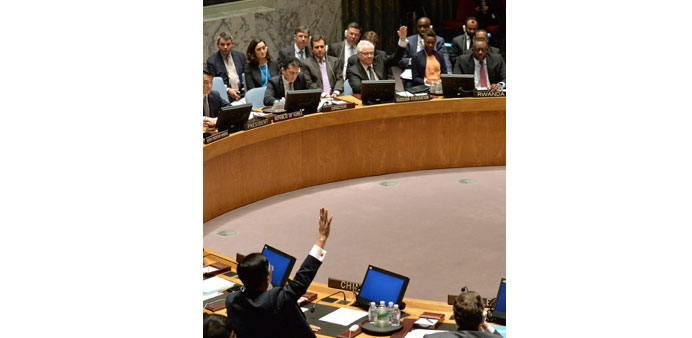
Vitaly Churkin (top centre), Russian Ambassador to the UN, and Wang Min, China’s deputy UN Ambassador (bottom left), vote against a resolution calling for the International Criminal Court to investigate alleged war crimes in Syria at UN headquarters in New York yesterday.
Reuters/United Nations
Russia and China vetoed yesterday a resolution to refer the situation in Syria to the International Criminal Court for possible prosecution of war crimes and crimes against humanity committed during the country’s three-year civil war.
This was the fourth time Russia - a close ally of Syrian President Bashar al-Assad’s government - and China have blocked UN Security Council action on Syria during the three-year civil war that has killed more than 150,000 people.
US Ambassador to the UN, Samantha Power, said the victims of the conflict “deserve to have history record those who stood with them and those who were willing to raise their hands to deny them a chance at justice.”
“Our grandchildren will ask us years from now how we could have failed to bring justice to people living in hell on earth,” Power told the council after the vote.
There were more than 60 co-sponsors of the French-drafted resolution, diplomats said. The resolution was put to a vote with the knowledge that it would be vetoed. The remaining 13 members of the council voted in favour of the resolution.
“If members of the council continue to be unable to agree on a measure that could provide some accountability for the ongoing crimes, the credibility of this body and of the entire organization will continue to suffer,” UN Deputy-Secretary-General Jan Eliasson told the council on behalf of Secretary-General Ban Ki-moon.
The ICC prosecutor cannot investigate the situation in Syria without a referral from the 15-member Security Council because Damascus is not a member of the Rome Statute that established The Hague-based court a decade ago. The Security Council has previously referred Libya and Darfur, Sudan to the ICC.
Russian UN Ambassador Vitaly Churkin questioned why the resolution was put to a vote when it would again expose disunity in the council, which had previously been able to agree resolutions on the destruction of Syria’s chemical weapons and demanding greater humanitarian aid access in the country.
“The draft resolution rejected today reveals an attempt to use the ICC to further inflame political passions and lay the groundwork in the end for eventual outside military intervention,” Churkin told the council.
“We’re convinced that justice in Syria will eventually prevail. Those guilty of perpetrating grave crimes will be punished but in order for this to happen peace is first needed,” Churkin said.
French UN Ambassador Gerard Araud dismissed Churkin’s explanation. “It’s a very say day,” he said. “Russia has not explained really well why it was opposing this referral.”
Chinese Deputy Ambassador Wang Min defended China’s veto, saying Beijing long had reservations about the council referring conflicts to the ICC.
Army breaks Aleppo prison siege
Syria’s army broke a siege of Aleppo prison yesterday, cutting off a major rebel supply route.
Tanks and armoured vehicles rolled into the grounds of the prison in the main northern city of Aleppo, more than a year into a rebel siege of the sprawling complex, the Syrian Observatory for Human Rights said.
The development puts the army and its allies, including Lebanon’s Hezbollah, within reach of Castelo Road, which rebels in Aleppo have relied on as a supply route leading to a countryside rear base.