


Bloomberg/Kuala Lumpur
Malaysian companies planning to sell sukuk under the government’s economic transformation programme are facing the highest costs in three years, as the central bank signals plans to raise interest rates.
Yields on 10-year AAA-rated corporate bonds that don’t comply with Islam’s ban on interest averaged 4.67% in 2014, the most since 4.88% in 2011 and exceeding the 4.3% in 2013, Bank Negara Malaysia data show. Borrowing costs rose to 4.547% at the most recent sale of sovereign Islamic debt due in 2028 on April 14, the highest this year, even as Shariah-compliant banking assets climbed to a record.
Rising yields threaten to complicate efforts by Prime Minister Najib Razak to trim the budget deficit to a seven-year low as costs climb for his $444bn development plan. A central bank statement on May 8 said the “degree of monetary accommodation may need to be adjusted” amid the fastest inflation in almost three years.
“There will be an impact from higher interest rates on Islamic borrowing costs and the government’s ability to cut its fiscal deficit,” Mohd Effendi Abdullah, head of Islamic markets at Kuala Lumpur-based AmInvestment Bank Bhd., Malaysia’s third-biggest sukuk arranger, said in a phone interview on Monday. “But the impact wouldn’t be too significant due to the abundant liquidity in the Islamic market.”
Islamic banking assets in the world’s biggest sukuk market climbed 12.5% to an unprecedented 556.5bn ringgit ($173bn) in 2013, according to the central bank’s annual report in March.
Malaysia’s one-year interest-rate swaps climbed above 3.5% last month for the first time since July 2011 and were at 3.64% as of midday in Kuala Lumpur, indicating investors anticipate the central bank’s borrowing costs will rise from the current 3%. Inflation numbers may show consumer-price gains held at 3.5% in April, matching the pace in the previous two months, the fastest in almost three years.
Najib is seeking to attain developed-nation status by 2020 by building roads, railways and utilities, with many of the projects farmed out to private or state-run enterprises. A goods and services tax of 6% will be implemented in April next year to boost revenue, he said in an October 25 budget speech.
While Malaysia has run a fiscal deficit since 1998, it reduced the shortfall to 3.9% of gross domestic product last year, the least since 2007, according to the central bank’s annual report on March 19. The government aims to cut the gap to 3.5% this year, Bank Negara said in the report.
The central bank last raised its benchmark overnight policy rate in May 2011, helping slow economic growth to 5.1% that year from 7.4% in 2010. Cutting the fiscal deficit is “already a challenge” but a rate increase won’t add an extra burden to that effort because of the GST benefits, said Edward Iskandar Toh, Selangor-based chief investment officer for fixed income at Areca Capital Sdn. “The interest-rate environment, which is expected to go up, will just mean slightly higher costs for borrowers,” Toh, whose company oversees 900mn ringgit, said in a telephone interview yesterday. “If the central bank allows it to happen, it would be to keep our ringgit competitive” in terms of yields, he said.
The ringgit has weakened 1% in the past six months, lagging behind the performance of six other major Asian currencies, including a 6.9% gain in the Indian rupee, the South Korean won’s 3.5% advance and the 1.9% appreciation in the Indonesian rupiah, data compiled by Bloomberg show.
Yields on Malaysia’s 10-year AAA-rated corporate notes reached 4.79% on April 21, the highest level since October 2011, and were last at 4.77% on May 14, the central bank’s index shows. DanaInfra Nasional Bhd., set up to finance a subway system in Kuala Lumpur under the government programme, sold Islamic bonds in April and October last year.
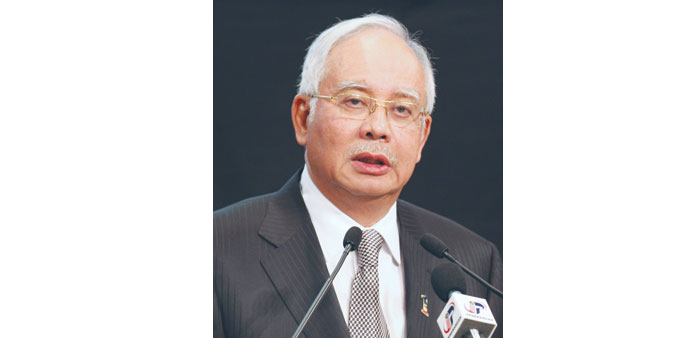
Najib: Set to turn around the economy.