


Agencies/Maiduguri, Nigeria
Suspected Nigerian Islamist militants killed 17 people in a remote northeastern village on Tuesday night, hours after a bomb killed 118 people in the central city of Jos, police said yesterday.
Militants opened fire on Alagarno village and razed several houses to the ground, a source at police headquarters told Reuters. The attack was barely 30km from Chibok, where Boko Haram Islamists abducted more than 200 schoolgirls last month.
Separately, police said men on motorbikes had killed nine people in a raid on the nearby village of Shawa on Monday.
There was no immediate claim of responsibility for either assault, but Boko Haram has either claimed or been blamed for scores of similar attacks in that part of Borno state, near the hilly border with Cameroon.
In the past two months, the group has redoubled its five-year-old violent campaign to carve an Islamic state out of religiously-mixed Nigeria.
Bomb attacks are growing more frequent and sophisticated, including two on the capital last month, and massacres of helpless villagers are an almost daily occurrence.
The Jos attack, if it was Boko Haram, showed how the group was spreading outwards from the northeast. Though it was not the first attack in Jos, it was by far the deadliest.
And the kidnapping of the schoolgirls highlighted just how powerless the security forces of Africa’s biggest economy and leading oil producer are to protect civilians from Boko Haram.
Two bombs on the outskirts of the capital, Abuja, last month killed 90 people between them, and on Sunday five people died in an attack in the north’s main city, Kano.
President Goodluck Jonathan, who has been criticised for his administration’s slow response to the schoolgirl hostage crisis, announced new measures to tackle the insurgents on Tuesday.
These included a multinational force around Lake Chad, comprising a battalion each from Chad, Niger, Cameroon and Nigeria.
But security sources say the army is ill equipped and sometimes poorly trained, while the insurrection it faces is well armed, and inspired by Islamist ideology.
“Currently, budgetary allocation for the military is inadequate to meet the contemporary security challenges and also cater for the welfare of the Nigerian Army,” major general Abdullahi Muraina, the army’s chief of accounts and budget, said yesterday.
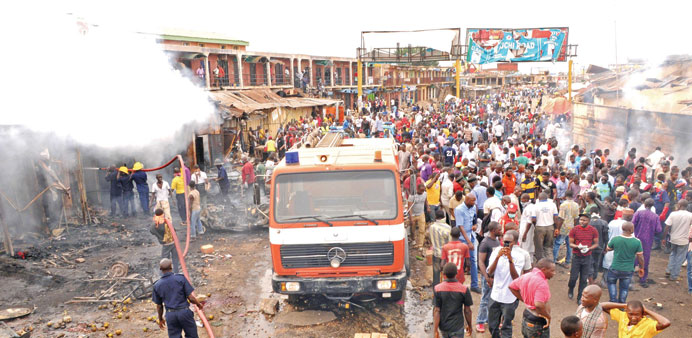
The scene of an explosion at Terminus Market in Jos on Tuesday.