


By Anand Holla
After putting in more than 40 years in the business, veteran orchestra administrator Kurt Meister was enjoying a relaxed, retired life at his Costa Blanca home in Spain when he received a message that would compel him to ditch his summer clothes and slip into a sharp suit.
It was the June of 2007. The message was from Qatar Foundation’s Chairperson HH Sheikha Mozah bint Nasser, asking Meister to create an orchestra of international class. “Her Highness told me: Bring the best musicians together… never mind their nationalities. Just get us the best,” Meister recalls.
For the German past master, who has spearheaded the Bavarian State Opera (in which he earlier also played the bassoon), and even The Bavarian Radio Symphony Orchestra that was recognised as one of the world’s top five orchestras, building the Qatar Philharmonic Orchestra (QPO) from scratch was the toughest challenge for two reasons.
He had to find and convince specialist musicians across the world to move to Doha, and he himself was way out of his comfort zone.
“It was really tough. To move to Arabia was something else. I didn’t know how many people would take this up. I went through some nights without sleep. I had six months to get them to sign the contracts,” says the Executive Director and the driving force of QPO.
Of 3,200 applications, 2,600 musicians were invited to try out their luck over six weeks of auditions across ten cities — Cairo, and nine European cities like London, Vienna, Madrid and Berlin. Leading players of top orchestras sat as jurors to cherry-pick talents that had to adhere to very high standards of musicianship, and a decidedly German-Austrian orchestra sound.
“We had to calculate too many variables; how many would come to audition, how many days they would be down for, and preparing a 65-page document on their work conditions and answer their endless questions. It was arduous. But in the end, we did well,” Meister says, with a smile filled with satisfaction.
On January 10, 2008, Meister met Her Highness, carrying proudly with him 101 signed contracts. He says, “When Her Highness asked me who I planned to bring in as the orchestra’s conductor, I assured her that I will get Lorin Maazel, former music director of the New York Philharmonic and one of the most revered conductors in the world.” And he did.
Be it in inviting soloists or convincing the big names, assembling the QPO made Meister draw a lot from his lifetime’s savings account of goodwill. “Fortunately, in my 40 years of being in the field, I developed contacts with the best in the world. Yet it wasn’t easy to convince people to come,” he says.
Things eventually fell in place. With 101 musicians from more than 30 countries — most being young, excited talents straight from conservatories — the QPO seemed ready to roll out the symphonies.
“But then the opera house wasn’t ready,” Meister says and shrugs. The 550-seat Opera House at Katara, which is now QPO’s home ground, would take another year to open. “To find the right hall was most important as an orchestra without a hall is nothing,” he says.
So returning to Doha with 101 contracts in his kitty was just Level One of his test. “We had to buy all the instruments and we were allowed to buy the finest,” says Meister.
At times, it took some convincing. “When I wanted to buy Steinway’s Grand Pianos, I was asked — why do you need such bland, boring Steinways when you can have such nice red Chinese pianos? I told them you can throw them out in three years. Steinways though will be the same 20 years from now,” Meister recalls.
Finding practice rooms to accommodate giant pianos and harps, or rehearsal spaces for the orchestra’s debut show, was a struggle initially. “Once, we were pushed into a small room with a glass roof. I was intelligent enough to not invite the timpani and other percussions there,” he says.
Once the teething troubles were overcome, there was no stopping QPO. “Step by step, we made our way up,” he says.
A walk through QPO’s home turf in Building 16 at Katara would tell you that they work hard to be where they are today. Strains of beautiful rhythms resonate dreamily from the many rooms and the Opera Theatre stage that the orchestra — separated for the practice session into soloists, sopranos, and the main section — is rehearsing at. The preps are for The Seasons of Haydn show.
Meister maintains that the QPO’s objective to be the bridge between Western and Arabic music, and be an ambassador of Qatar, hasn’t changed. “It’s crucial for us to bring messages from both Arabic and Western cultures, and blend cultures,” he says.
Even its programming has been pretty open to experimentation. While it started out as a mix of Western Classical staples and new Arabic compositions by its founding director and noted Lebanese oud player Marcel Khalife, it throws in some world music in good measure every once in a while.
Having the South Korean Han-Na Chang as QPO’s Music Director has only enhanced its vibrance, feels Meister. “She is so passionate about the orchestra,” he says.
Initially, the board asked Meister to bring at least one Arabic concert a month. “But the Arab audience didn’t show up. The Arabs love film music, piano concerts, and of course if you get Omar Khairat (genius Egyptian composer), you have a full house,” he says, and laughs.
“However, some Qataris have come for all our concerts over these years. It’s only when they were unwell that they have missed any. They love the music and convince others to do so, which we find encouraging,” Meister says.
As for the free-for-all chamber music concerts held on the first Thursday of every month in the Museum of Islamic Art for the past two years, the idea is to integrate all art. “Art should not be limited to music or paintings,” he says.
Apart from holding around four Western Classical music concerts a month, the QPO also manages to hold regular school concerts in Arabic, children’s concerts, and a family concert. “It’s important for children’s concerts to be interesting. They shouldn’t sit still as if they are in a museum. If they find it boring the first time, it will be their last time,” Meister points out.
In that lies a greater point — to educate children in music. “That’s really important. Also, it’s proven that learning an instrument is wonderful for the development of a child’s brain. We find it heartening to see children who come to our concerts, leave saying: we will now learn an instrument.”
Similarly, does he see a larger social significance of nurturing an orchestra? Meister says, “Qatar has many inspiring messages to offer to the world. But let’s put across another one; not from oil, not from gas, but from culture. A country can’t run only on its economy. A country without culture looks very poor.”
It’s not that Meister is devoid of examples to justify his belief. “When the Hungarian ambassador was leaving Qatar last year, he was asked what he found to be the best thing in Qatar in the last five years. The ambassador said QPO. When asked why, he said that before, he never knew his colleagues,” says Meister, with a glint in his eyes, “A QPO concert is a new cultural meeting point now for everybody from diplomats to bankers.”
Meister pauses, as if to draw some more from his thoughts, and then says, “People of Qatar needed something. And QPO has now become an important part of Qatar.”
To march forward in its ambitious journey, the QPO is excited about getting a massive recording studio in Katara, where at least 100 musicians can record with top-of-the-line recording equipment. “We have been invited by the BBC to perform. The Qatar Philharmonic is something really special now,” he says.
Just as QPO’s emergence as the region’s foremost musical force, the idea of Qatar, too, has undergone a sea change, feels Meister. “We are seeing a totally opposite wave from what we saw five years ago,” he says, “People didn’t know much about Doha and were reluctant to move here. It’s so different now.”
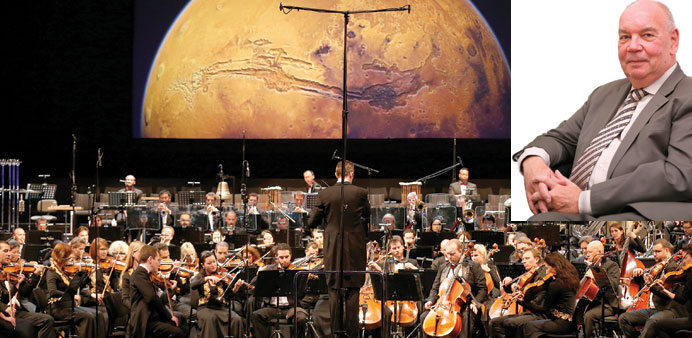
When Meister needed six percussion players for their recent The Planets concert, they had to get musicians from abroad. “Five years ago, we would have had to beg them to come. Today, we have a waiting list,” Meister says, with a chuckle.
Top conductors are keen to come down as well. “Believe me, my budget is really low,” Meister says, “So recently, when I requested a very famous artist to fly down, he told me: Mister Meister, this fee you have offered me is less than what all the East European orchestras are offering me. I told him: Sorry sir, you can come if you wish.”
So did he? “Oh yes, he did,” says Meister.