


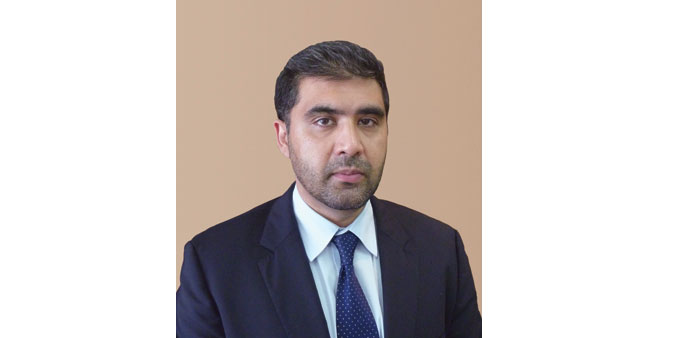
An official of Islamic financial institution QInvest will be participating in the “10th Annual World Islamic Funds and Financial Markets Conference” to be held on May 19 and 20 at the Gulf Hotel in Bahrain.
QInvest managing director and head of asset management Dr Ataf Ahmed will be one of the panelists of a “CEOs and Industry Leaders Power Debate” on the first day of the conference with the topic “Attracting More International Investors to Islamic Financial Markets.”
During the discussion, Ahmed and fellow panellists will explore ways to grow the global Islamic finance investor base by expanding beyond traditional Islamic finance markets.
“Islamic finance is an industry estimated to be more than $1.6tn and has the potential to go far beyond that. At the moment the industry is concentrated on pools of liquidity in the Mena region and countries such as Malaysia,” Ahmed said.
He added that with conventional issuers looking for ways to diversify their funding, Islamic finance has the potential to grow at an “exciting rate” in markets across Europe and Asia.
Ahmed said QInvest’s participation in the conference came after the firm recently launched a range of innovative Shariah-compliant funds in collaboration with QIB, known as the Shiraa Funds.
Shiraa Funds is investing into a selection of global Shariah-compliant funds drawn from QMAP (QInvest Managed Account Platform) and spanning across international equity and sukuk markets with the objective of delivering sustainable and attractive long-term performance to investors.
Ahmed said QMAP funds offer investors a “very strong” risk-adjusted return over the medium to long term and constitute a convenient way to build a solid investment portfolio, which is diversified across the main asset classes, geographies and industries in a Shariah-compliant and straightforward manner.
Eligible investors have a choice of funds to match their personal preferences and profit aspirations. Each of the funds offers a different level of potential return and hence, carries a different level of associated risk, he added.