


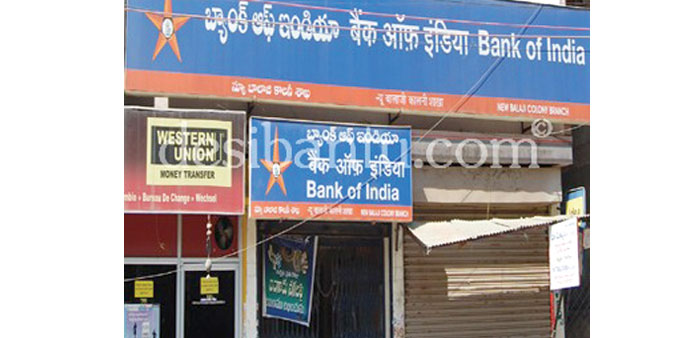
A Bank of India branch is seen in New Delhi. Sources said yesterday that the bank has hired half a dozen firms to help raise $400mn.
Reuters/Mumbai
Indian state banks plan to tap capital markets for billions of dollars after a new government takes office, executives and bankers say, betting on a revival in credit demand and giving them a chance to shore up battered balance sheets.
State lenders, which control roughly 75% of the banking industry, are looking to raise funds from the market instead of relying on capital infusions from the cash-strapped government.
It’s a shift that could set the stage for New Delhi to follow an influential recommendation by a panel appointed by the central bank to reduce its holdings in the lenders to below 50%.
The opposition Bharatiya Janata Party (BJP), led by prime ministerial front-runner Narendra Modi, is widely expected to form the next government. Investors are counting on a Modi-led administration to revive faltering economic growth and corporate investment.
Election results will be announced today.
“If the government is positive and announces some policies which are positive and conducive for investment and growth, corporates will plan their expansion and all, which will result in credit demand,” said Sudhir Kumar Jain, chairman of 67% state-owned Syndicate Bank. He told Reuters his own bank is finalising plans to raise as much as $720mn, mostly in dollar bonds.
Canara Bank, 69%-owned by the state, plans to raise 15bn rupees ($251mn) though the sale of shares this fiscal year and expects a government equity infusion of the same amount, chairman RK Dubey told Reuters by e-mail.
Indian state banks have been badly hit by the country’s slowest economic growth in a decade, which has stifled loan demand and sent bad loans surging. They also need massive amounts of funding to meet the global Basel 3 capital adequacy requirements introduced to safeguard banks’ financial health in the wake of the 2008 global financial crisis.
The external central bank panel said on Tuesday that state lenders will need up to $98bn in tier 1, or core, capital by March 2018 to meet capital rules and provide for bad loans.
The panel also recommended that New Delhi bring its ownership of lenders below 50% and reduce government influence in banks. Such measures are politically difficult but may take on greater urgency as the new government looks to shore up its finances and avoid a cut in India’s credit rating to junk.
Last year, share sales by Indian banks, mostly in the private sector, more than halved to $756.9mn, while bond issuance fell 20% to $8.4bn, Thomson Reuters data shows. In recent years, state banks have relied on government capital infusions as a slowing economy and worsening asset quality soured investor demand.
But that’s about to change. “The government cannot give much support because of the fiscal constraints,” said Kuntal Sur, a partner at KPMG.
Other state-owned banks looking to tap markets include Bank of India Ltd, which has hired half a dozen banks to help raise $400mn through bonds, sources with direct knowledge said. Its chairwoman did not respond to calls for comment.