


By Pratap John/Chief Business Reporter
Supply constraints mainly due to the current geopolitical situation may drive oil price up, Samba Financial Group has said in a report even as it revised the average Brent price forecast to $104 for a barrel this year.
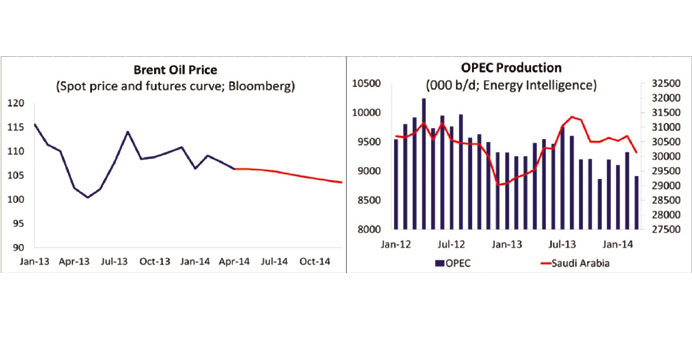
“While the fundamentals of the oil markets continue to point to weakness as projected global non-Opec supply exceeds global demand growth; disruptions in Opec supply, and limited spare capacity at a time of elevated geopolitical tensions, are likely to continue to provide support to prices,” Samba said in its latest economic monitor.
“Clearly, downside risks are widespread, as there exits potential for large supply gains in Libya, Iran and Iraq, while global demand remains muted. However, on the basis of price developments in the year to date, and our assumptions that supply will continue to be constrained, we have revised up slightly our average Brent price forecast to $104 this year,” Samba said.
Escalating tension in the Ukraine has raised the risk that energy supplies from Russia, including oil, could be disrupted or subject to sanctions. For now, this still seems a worst-case scenario, but oil prices rose on the heightened geopolitical risk, with Brent trading near $110 in late April, before slipping back.
The year-to-date average price remains around $107, similar to the annual average last year. As well as geopolitical risk premiums, prices continue to be supported by disruptions to physical supply in Opec producers, which are offsetting sustained production gains in the US and Canada, it said.
Despite bearish underlying fundamentals, the oil market outlook is subject to a range of mainly political, uncertainties that will have a major bearing on supply and price developments. Perhaps, the two most pertinently affected are Libya and Iran, Samba said.
Developments in Libya will clearly have a major bearing on the supply outlook. Here prospects still look bleak, and we expect that political tensions and dysfunction will continue to disrupt supplies. In Iran, everything hangs on the whether the scheduled June negotiations on its nuclear activities result in a full lifting of sanctions and subsequent surge in oil exports and production.
While Iranian adherence to constraints and monitoring of its activities seems to be going well, Samba still thinks that the most likely outcome is a rollover of the existing interim agreement.
Elsewhere developments in Iraq will have a major bearing, and a sustained increase in production there could drag on prices.
The current sanctions on Russia seemed unlikely to disrupt oil flows in a significant way, but the risk of an escalation was clearly there, Samba said.