


AFP/London
A mural by US artist Mark Rothko that was vandalised by a Polish man went back on display yesterday at the Tate Modern gallery after a year-and-a-half of restoration work.
Wlodzimierz Umaniec scrawled his name and a slogan advertising his own artistic manifesto on the 1958 painting Black On Maroon in October 2012.
Experts had to painstakingly remove the ink Umaniec used with a special solvent before restoring the surface of the artwork, valued at £50mn.
Tate director Nicholas Serota said he was “delighted” the painting, one of the Seagram Murals set, was back on display despite initial fears it could never be repaired.
“To see the extent of that damage later that day, one had no idea whether it would be possible to restore it or not,” he told a news conference.
“The result is much more successful than we could have hoped for.”
Wlodzimierz was jailed for two years for the attack, during which he scrawled his autograph and the words “12 a potential piece of yellowism” in indelible ink on the Rothko masterwork.
Conservation experts said it took nine months of microscopic analysis to find a chemical solvent that could dissolve the ink, which had penetrated several layers and in some areas soaked through to the back of the canvas.
They then used test canvases, including one that Rothko himself had primed with maroon paint when the Seagram murals were commissioned for New York’s Four Seasons restaurant in 1958, to try out their methods.
A further nine months was spent removing the majority of the surface ink before reversible conservation-grade materials were used to restore the painting’s surface.
Tate said the damage will always remain under the surface of the work but it had now been restored to “displayable condition”.
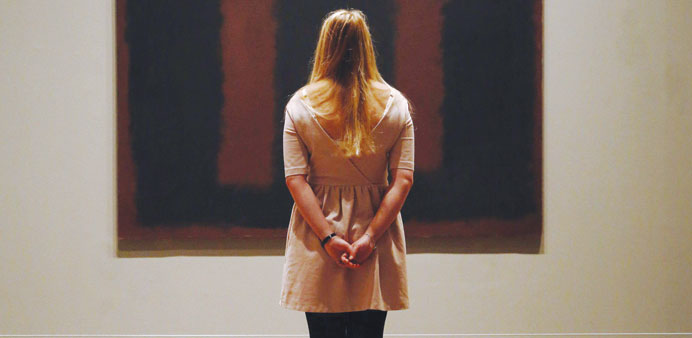
A member of Tate staff poses with the restored Mark Rothko artwork Black on Maroon, 1958 at the Tate Modern in London yesterday.