


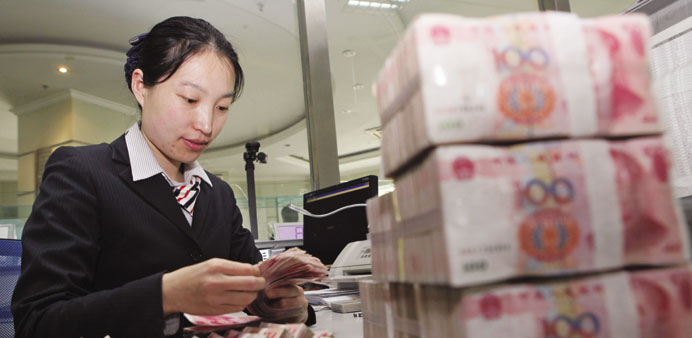
A teller counting notes in a bank in the Jiangsu province. China’s yuan will one day compete for a place alongside the mighty dollar as a reserve currency hoarded by central banks, analysts say, as US Treasury chief Jacob Lew visits Beijing to push for faster reform.
China’s yuan will one day compete for a place alongside the mighty dollar as a reserve currency hoarded by central banks, analysts said, as US Treasury chief Jacob Lew urged faster reform on a visit to Beijing.
Communist authorities tightly control the rate of the yuan – also known as the renminbi (RMB) or “people’s money” – and limit capital flows into and out of the country.
But China – already the world’s second largest economy – is gradually moving to implement financial reforms, make its exchange rate more flexible, and open its capital account for investment and financial transactions, rather than trade-related ones.
The slow pace of change, though, has frustrated Washington, and Lew told Chinese Premier Li Keqiang it was “critical” Beijing continue to reform its currency controls to foster more balanced global trade. “It is important that China demonstrate a renewed commitment to move to a more market-determined exchange rate and a more transparent exchange rate policy,” he said.
China’s efforts so far have focused on transforming its special administrative region of Hong Kong into the world’s centre of “offshore” yuan trading, where banks take deposits and financial institutions issue bonds denominated in the currency.
An agreement announced last month will let Chinese investors buy and sell on the Hong Kong stock market using yuan, while a free-trade zone launched in the commercial hub Shanghai last year aims to pilot reforms for full convertibility of the currency.
“Clearly the renminbi has traction. If you look at any measure of the renminbi’s internationalisation... the trajectory looks very sharp,” said Eswar Prasad, economics professor at Cornell University and author of “The Dollar Trap”, which argues that the ubiquitous greenback is an inescapable necessity for now. “If China moves forward with its financial market and economic reforms, the renminbi will become a viable, possibly significant, reserve currency,” said Prasad, previously head of the IMF’s China division.