


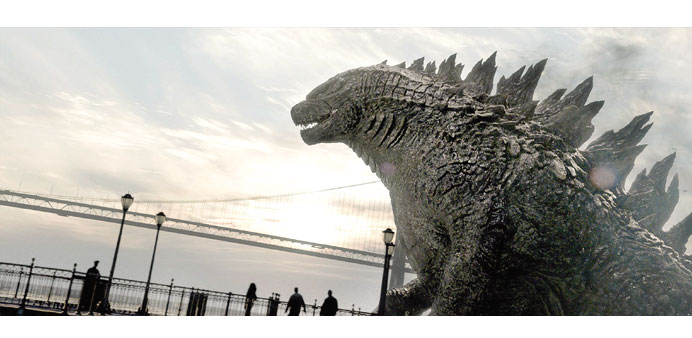
New Godzilla brings modern sensibility to iconic Japanese giant lizard. By Rene Rodriguez
Godzilla, director Gareth Edwards’ $160mn reboot of the classic monster, hasn’t even opened yet and already the movie is under attack.
According to The Japan Times, diehard fans of the creature have taken to the Internet to complain the United States has done a “Super Size Me” number on the giant fire-breathing lizard. “He got fat in America on Cola and pizza!” is a typical complaint. “Couch potato Godzilla” is another.
But Edwards is taking the criticism in stride.
“I don’t know which pictures they’ve seen, but I don’t think he’s fat,” the filmmaker says, chuckling. “He’s just big-boned. Plus he’s middle-aged. You tend to get a little bulky.”
This is not meant to suggest that Godzilla, which opens May 16, is in any way campy or humorous. Unlike the last time Hollywood tried to revive the popular monster (Roland Emmerich’s 1998 jokey, reviled misfire), the new film is dead serious in tone and mood, treating its central character and the theme of man vs nature with the same gravity and seriousness director Ishiro Honda brought to the 1954 Japanese original.
“In the mid-1950s, Hollywood started a trend of films that addressed Cold War fears with science fiction allegories, but Japan had a special edge when it came to doing the same thing,” says David Kalat, author of A Critical History and Filmography of Toho’s Godzilla Series.
“When the first Godzilla film was made, Japan had endured wartime firebombings of Tokyo, the atomic bombings of Hiroshima and Nagasaki and the H-bomb tests in the Bikini Islands that killed Japanese citizens in peacetime and irradiated a significant amount of the food supply. They must have felt like the world was coming to an end. But because the country was still coming out of post-war censorship imposed by the American occupation forces, there was no way to talk about the massive cultural trauma openly.
“Godzilla was a way for Japan to address some of these traumas, safely disguised as a monster movie so no censors would get upset.”
Although he was originally intended as a metaphor for apocalyptic terror, Godzilla grew tamer and sillier in subsequent sequels and spinoffs over the decades, becoming a cartoonish, kid-friendly version of himself. Even Hanna-Barbera, the animation studio that spawned The Flintstones and Scooby-Doo, created a cartoon show in the 1970s built around the monster.
“There is no one Godzilla,” says Max Borenstein, who wrote the screenplay for the new movie. “The first film is an allegory for nuclear warfare, and Godzilla is explicitly a walking manifestation of the atomic bomb. That evolved into so many reiterations over time that every movie has a different take on the monster and what he represents. The common denominator is that Godzilla has always represented a force beyond our control.
In the 1960s, it got a little campier, but he represented the fear of alien invasion. In the 1970s, he became a symbol for environmental fears, fighting smog monsters. We had to look back and find the common denominator in all of his incarnations and ask ‘What feels resonant now? What are the visceral fears of today?’ The answer we settled on is that Godzilla is a vessel for the fears of all humanity — a force of nature that is so beyond our control, he reminds us we are mere insects on this planet.”
Godzilla centres on Navy officer Ford Brody (Kick-Ass Aaron Taylor-Johnson), who has just returned home from a tour of duty to his wife (Elizabeth Olsen) and son in San Francisco when he’s asked to fly for an emergency to Japan, where his parents (Bryan Cranston and Juliette Binoche) worked at a nuclear power plant alongside a scientist (Ken Watanabe).
The reason for the distress call — and what Ford finds when he gets there — is one of the film’s many surprises, few of which have thus far, miraculously, been spoiled by trailers. Unlike Michael Bay’s Transformers franchise, which features giant robots duking it out in fights so frantically edited they’re often incomprehensible, Edwards uses a refreshingly different approach to Godzilla, holding on the monster for long shots so you can process the larger-than-life action that’s taking place on screen (the film works even better on a 3-D IMAX screen; this sucker is huge).
But Edwards also makes you wait, teasing you with glimpses before you get to have a good look at his main attraction, the way Steven Spielberg teased the audience with the shark in Jaws.
“I speak with an English accent, because I grew up in England,” Edwards says. “I also grew up watching certain films, and the effect is the same: They rub off on you. ‘Close Encounters of the Third Kind’ really broods and builds incrementally. The movie takes its time, but when they finally show you the spaceship at the end, they really hold on it, so you can take it all in. That was the only way I could think of doing Godzilla. I watch modern movies and can appreciate the contemporary style, but the movies we talked about the most while on the set were things like Jaws and Alien and Apocalypse Now.”
“Today there’s a sense that audiences have less tolerance for development and a shorter attention span,” Borenstein says. “If you see everything right from the beginning, what do you have to look forward to? You get tired and bored. So we really tried to build suspense into every set piece. You know it’s coming, but you don’t know how or when. We studied things like ‘Jurassic Park,’ in which you see aspects of the creature and you feel its presence, but you don’t really get to see it until halfway through the film.” — The Miami Herald/MCT
Carey Mulligan happy to be in London
Actress Carey Mulligan says there is something special about working in her hometown and that it is refreshing to see her family after a long day on set here. The 28-year-old star, who is married to musician Marcus Mumford, has returned to film her new movie Suffragette with Meryl Streep, and to star alongside Bill Nighy in Skylight.
“I’m really happy to do something in London,” femalefirst.co.uk quoted her saying. “And to go home to my house every night, and see my friends and family, and have people who never usually get to see me on stage see it. There’s something about doing it in a hometown that feels a bit special,” she added. — IANS
Chris Martin was ‘hard to live with’?
Singer Chris Martin was reportedly “hard to live with” before he split from wife and actress Gwyneth Paltrow. The former couple — who have children Apple, 9, and Moses, 8, together — split in March after 10 years of marriage, and insiders claim the Coldplay frontman’s insecurity caused a lot of their problems, reports femalefirst.co.uk.
“Chris is very tough on himself and that can be hard to live with. There was a time a few years ago when there were a lot of fights,” Britain’s Grazia magazine quoted a source as saying. Martin’s insecurity made him “hard” for Paltrow to live with. “He and Gwyneth had a great life but it was like he couldn’t quite see it and couldn’t commit to it. There were other issues that sparked off that and, ultimately, they ended up leading very different, very separate lives,” said the source. — IANS
Courteney Cox in Cougar Town finale season
Actress will return to Cougar Town for one final series. Courteney Cox The former Friends star’s contract with Cougar Town has been renewed by the bosses at US TV network TBS for a sixth and final season, reports femalefirst.co.uk.
The TV show debuted in 2009 and the season finale, which consists of 13 new episodes, is slated to air in the US early 2015. Cougar Town debuted on channel ABC but was cancelled by network bosses in 2012. But TBS executives picked up the comedy, which also stars Christa Miller, Busy Philipps and Dan Byrd. — IANS