


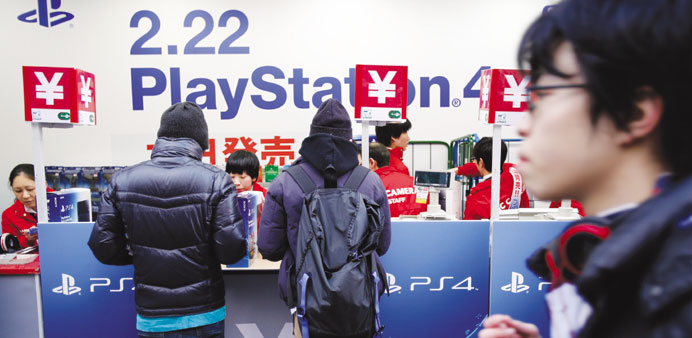
Customers purchase Sony PlayStation 4 video game consoles at a Bic Camera electronics store in Tokyo. The company is set to report its fourth annual loss in five years tomorrow.
Two years after Kazuo Hirai took over as chief executive of Sony Corp, it is slipping into a familiar pattern. After telling investors that a turnaround was at hand, the company is set to report its fourth annual loss in five years tomorrow.
Consumers have moved on to brands such as Apple and Samsung. Ratings agencies have downgraded Sony’s debt to junk status. And longtime Sony watchers fear Hirai is more focused on casting off its failures than on finding the hit product that could restore its reputation as one of the most innovative companies of the past century.
“Hirai delivers outward messages that are positive. But there is still the image that products that don’t make money are dumped, while there is no longer-term vision for what kind of a new lifestyle Sony wants to create,” said Shingo Tamura, a former engineer who left Sony in 2006.
Hirai, who is set to reveal Sony’s long-term strategy on May 22, has promised to rebuild the company’s troubled electronics arm around three pillars: games, imaging technology and mobile devices.
“Sometimes at Sony, we zigzag our way to great innovations, and simply other times, we fail,” he said at a Las Vegas trade show in January. “But, you know, at Sony, failure is not really an end. It’s a reason. It’s a reason to keep trying.”
The company declined to comment for this article ahead of the earnings and strategy briefings.
Sony’s new game system, the PlayStation 4, is performing well. Through early April, Sony had sold more than sevenmn PS4 consoles in its first five months on the market, beating Microsoft Corp’s new Xbox One console.
Sony also sees promise in its high-definition portable music players, which it is selling under the Walkman name, as well as 4K televisions that offer improved picture quality. Other gadgets, such as motion sensors that can be attached to tennis rackets, are aimed at rebuilding Sony’s brand.
The problem is that so far, none of the growth areas seem capable of transforming Sony’s bottom line. The 4K TVs, for example, make up less than 10% of global TV sales, and it is hard for niche products to move the needle at a company with around $75bn in annual revenue.
Less than two weeks ago, Sony forecast a loss of ¥130bn ($1.3bn) for the fiscal year that ended in March – a sharp swing from the 30bn yen profit that it had earlier predicted. Troubles in electronics again outweighed profits from movies and music.
Even the PlayStation isn’t the cash cow it once was, because consumers are spending more time playing on smartphones. Sony’s sales target of 20mn units of PlayStation hardware for the just-ended fiscal year is 45% below its level six years ago.
Sony said in February it would sell its personal computer business and set up its TV business as a separate, though wholly owned, unit. The company is booking much of the cost of that restructuring in the just-ended year, leading some investors to say the worst may be over.
“I don’t know when their next hit product will [come] or when their restructuring is going to stop, but at least they’re on the right track, “ said Arnout Van Rijn, chief investment officer at Robeco Hong Kong, whose fund has been investing in Sony shares for nearly a decade. “So far it’s been taking disappointingly long, but eventually that value will be there.”
A viable mobile business seems like a prerequisite for success in consumer electronics, given that smartphones bundle together the roles once played by Sony products such as the PlayStation, the Walkman and Cyber-shot cameras.
In 2012, the year Hirai became CEO, Sony made progress toward his goal of establishing the company as a clear No. 3 in smartphones, behind Samsung Electronics Co and Apple Inc helped by strength in Japan and Europe, where Sony still benefits from the legacy of a defunct partnership with Ericsson of Sweden, Sony’s share of the global market climbed to 4.3% in 2012, according to IDC, a research firm.
Last year, Sony slipped back to 3.8% and stood in sixth place. While the company’s Xperia smartphones have received favourable reviews, consumers see few compelling reasons to trade in their iPhones or Galaxy handsets. Inexpensive Chinese handsets control the low end of the market, and in the US, Sony lacks strong relationships with mobile carriers.
The company has said it won’t pursue market volume and be dragged into price competition on smartphones, although it has released less-expensive models for emerging markets.
Sony has had more success with one of the key components of smartphones-the built-in cameras. Sensors made by Sony are used in iPhones and a number of other smartphones. That buttressed one of Hirai’s three growth pillars, the company’s imaging business. Yet even the sensor business faces challenges. Samsung, which previously used Sony sensors in its flagship phones, turned to in-house imaging technology for its current top-of-the-line handset, the Galaxy S5.
Many of the questions about Sony’s future centre on its identity as a consumer-electronics company. Its profits today largely come from disparate businesses such as Hollywood movies, recorded music and a bank and life insurance unit in Japan. Adding to the impression of disjointedness, Sony said in April that it would invest $2mn to start a real-estate brokerage in Japan.
Other Japanese technology giants such as Panasonic Corp, Toshiba Corp and Hitachi had big parts-making operations and industrial businesses to fall back on when their consumer businesses ran into trouble. All three reported profits in the just-ended fiscal year.