


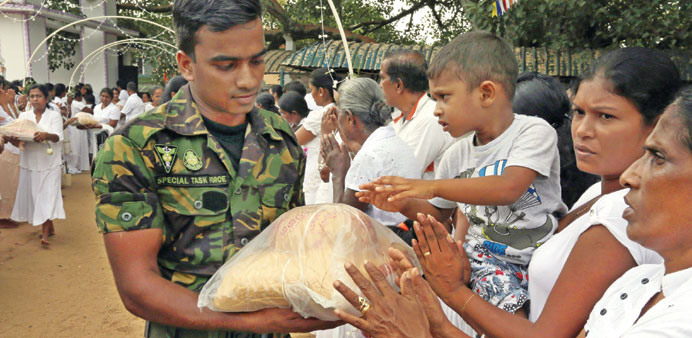
Ceremony remembering end of conflict: Devotees touching the offering held by a member of the Sri Lankan Police Special Task Force at a ceremony at the Sri Kalyaniwansikaramaya in Makola, near Colombo, yesterday. The bowls contain herbal medicines, oils and one thousand ‘pirikara’ or Buddhist monk’s basic essentials invoking blessings on those who died and were injured in the island’s war against terrorism. The nearly 30-year conflict between the Sri Lanka armed forces and the separatist Liberation Tigers of Tamil Eelam ended in May 2009. Various estimates put the number of deaths as over 20,000 Sri Lankan soldiers and 1,000 Sri Lankan police personnel.
AFP
Sri Lanka has banned public commemorations of Tamil Tiger rebels ahead of the fifth anniversary of rebel supremo Velupillai Prabhakaran’s killing which marked the end of the war, a military spokesman said yesterday.
Brigadier Ruwan Wanigasooriya said public events to commemorate Liberation Tigers of Tamil Eelam (LTTE) rebels killed in the final battle of the decades-long separatist war, were barred as the organisation remained
outlawed.
“Individuals may have religious services to commemorate their loved ones killed in the fighting, but there cannot be any public events,” Wanigasooriya said.
“Display of LTTE flags or insignia will also not be allowed,” he added.
Government forces killed Tiger supremo Prabhakaran on May 18, 2009 and declared an end to 37 years of armed conflict, which the UN estimates claimed at least 100,000 lives.
Rights groups have said that up to 40,000 civilians perished in the final months of fighting alone in the island’s northern coastal district of Mullaittivu where the rebels put up a final stand.
The government’s latest ban on Tiger commemorations follows military claims that rebel remnants were trying to regroup and rearm to renew their campaign for a separate homeland for the ethnic
Tamil minority.
Human rights groups have accused Colombo of trying to whip up fears of a Tiger resurgence to justify draconian anti-militant laws and to maintain a large military presence in the former war zone.
The military last month shot dead three Tamil men accused of trying to revive the LTTE in the island’s north.
There had been no major attacks blamed on Tamil Tigers since their defeat in 2009, but Sri Lanka’s navy said it found the largest stock of buried LTTE pistol ammunition in Mullaittivu on Friday.
Troops found 120,000 pistol rounds along with 8,000 rounds of other ammunition. The navy released photographs of the ammunition from what it said was the same area where the final
battles were fought.
The government has banned other Tamil commemorations of the war in the past, including events to mark the LTTE war dead last November.
Meanwhile, the military is planning a parade on May 18 in the island’s Sinhalese heartland of Matara, south of Colombo, to commemorate the victory over the rebels,
Wanigasooriya said.
“This victory belongs to each and every citizen of this country irrespective of any perceived differences,” Wanigasooriya said.
The Tigers, who during the height of their power controlled nearly a third of Sri Lanka’s territory, were known for their trademark suicide bombings, which claimed high-profile targets, including a president in May 1993.