


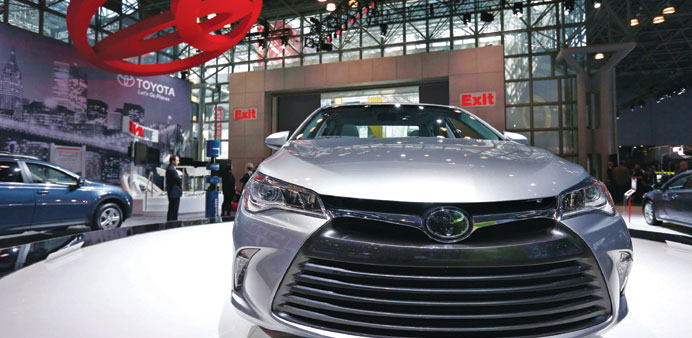
The new Toyota 2015 Camry is displayed after the unveiling at the 2014 New York Auto Show. The Japanese auto major will crank up production of the Camry sedan, the top-selling US car for the last dozen years, at its Kentucky plant.
Bloomberg
Toyota Motor will crank up production of the Camry sedan, the top-selling US car the last dozen years, at its Kentucky plant after it stops farming out some manufacturing to Fuji Heavy Industries.
Toyota will move Camry production of about 100,000 units to Kentucky in the second half of 2016, it said on Friday. The move will free up more capacity in Indiana for Tokyo-based Fuji Heavy, whose Subaru brand is on pace for a sixth consecutive annual sales record.
Making up for the lost Subaru capacity keeps Toyota in position to defend the model’s lead over Honda Motor Co’s Accord, Nissan Motor Co’s Altima and Ford Motor Co’s Fusion. To fend off mounting competition, the world’s largest automaker is making styling changes midway through Camry’s typical five- year design cycle by introducing a restyled version with more contoured body panels and sportier handling.
“Every time I speak with Toyota people regarding Camry sales or Camry incentives, they always say ‘Camry is different; Camry is special,’” Kei Nihonyanagi, a Tokyo-based equity analyst for Bank of America Corp’s Merrill Lynch, said by telephone. “Securing the No 1 position in the US is very important to Toyota.”
Camry’s US deliveries have slipped 0.2% through the first four months of this year after rising 0.9% in 2013, when the car lost market share in the mid-size sedan segment to Accord, Altima and Fusion.
Toyota’s American depositary receipts rose 0.7% to $108.87 at the close in New York. They have fallen 11% this year.
Squeezing 100,000 more Camrys into Toyota’s Georgetown, Kentucky, plant, already one of the largest auto-assembly sites in North America, requires planning and investment, said Jeff Liker, an engineering professor at the University of Michigan in Ann Arbor who studies Toyota’s manufacturing system.
“I’m pretty confident they’ll have to make an expansion at Georgetown to accommodate that move, but they’ve got some time to figure it out,” Liker said in an interview. “Toyota wants to load up its plants - the higher the capacity utilization, the lower the fixed costs.