


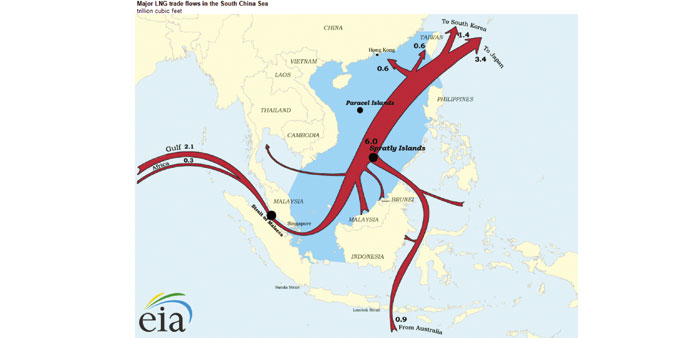
The escalation of the long-lasting conflict in the South China Sea between oil-and-gas-dependent nations such as the Philippines, Vietnam and China could reduce petroleum supply in the region and global petroleum trade, experts say.
The tensions are about claims of ownership of several archipelagoes, islands and shoals in the waters off the Philippines and Vietnam, which are seen by China as its own territory. Brunei, Malaysia and Taiwan also have competing claims.
Since May 3, the conflict escalated when Vietnamese naval ships and Chinese vessel collided off Vietnam as the Vietnamese navy tried to prevent the Chinese from setting up a $1bn oil rig in the area. Vietnamese officials said Chinese ships “intentionally rammed” parts of the Vietnamese fleet and attacked them with water cannons. On May 7, the Philippines navy seized a Chinese fishing boat and detained its crew in another disputed area in the south — Gulf Times reported.
As much as the conflict is about oil reserves in the region, observers say it could seriously disrupt supply from the Middle East to East Asia and also lead to higher prices on the world market. And it could also backfire on the Middle East as both regions are highly dependent on each other in the current demand-and-supply scenario. Asia’s share of Middle Eastern oil and gas exports grew from 57% in 1999 to 75% in 2013, and petroleum trade from the Middle East has increasingly “turned East” in the past years in the wake of the economic crises in Europe and the US, according to John Mitchell, expert at UK-based think tank Chatham House.
Moreover, the South China Sea is one of the most important energy trade routes in the world. Almost a third of global crude oil and over half of global liquefied natural gas (LNG) passes through the South China Sea each year, on its way mainly from the Arabian Gulf through the Strait of Malacca towards China, South Korea and Japan. This makes the shipping passage almost as important for international oil and gas trade as the Strait of Hormuz. Furthermore, it is also an important route for processed petroleum, which is shipped from refineries in Singapore and Malacca as gasoline and jet fuel to through the South China Sea to China and Japan, the two largest energy consumers in Asia, as well as to South Korea and Taiwan.
As for LNG, Qatar is the largest supplier of the region. About 6tn cubic feet of LNG are passing through the South China Sea each year, according to the US Energy Information Administration, a large part of which is shipped from Doha. Any continued conflicts in the area will likely have an impact on LNG trade.
It is not expected that the tensions will calm down any time soon, especially since the US and the Philippines now have signed a defence co-operation and just recently started joint military drills in the region, accompanied by sharp criticism by US officials over China’s actions, which has triggered an angry reaction in Beijing, saying that “the US has no right to make irresponsible remarks about China’s sovereign rights,” lifting the conflict to the superpower level.