


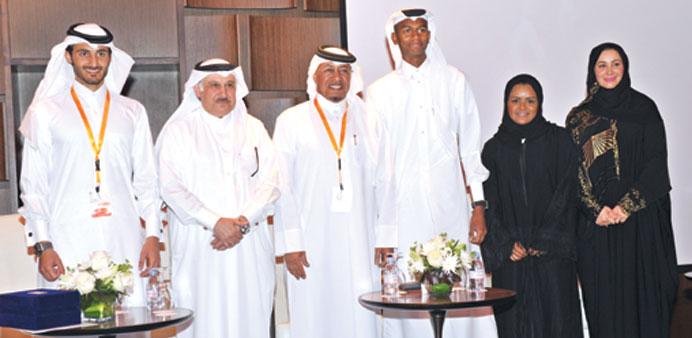
(From left) Qatari Everest conqueror Sheikh Mohamed bin Abdullah al-Thani, director general of Sharjah Statistics Center, Dr Mohamed al-Sayrafi, general manager of Anti-Doping Laboratory Qatar (ADLQ), Dr Saif Ali al-Hajri, chairman of Sport and Environment, Mutaz Barshim, Maryam al-Suwaidi and Mashael al-Ansari, ADLQ Marketing and Communication director at the ADLQ 4th Symposium at Torch Doha Hotel yesterday.
By Anil John/Doha
Mutaz Barshim revealed yesterday how a painful spine injury and a mountain of self-doubt had almost scuttled his participation in the 2012 London Olympics.
At a panel discussion sparkling with wit and brimming over with emotion, the 22-year-old champion high-jumper told the audience that just weeks before the Olympics he was so low on confidence he had even stopped following his diet regimen.
“I had almost given up. With just two months to go for the Olympics I was in such severe pain that I wanted to pull out. I was so down mentally that I gave up eating properly and was only eating cornflakes for breakfast, lunch and dinner,” Barshim said during the discussion held at the Torch Doha Hotel as part of the Anti-Doping Lab Qatar (ADLQ) seminar on ‘anti-doping, sport integrity and public health.’
Barshim, who suffered a stress fracture in the fifth (L5) Lumbar vertebrae in early 2012, however said he eventually overcame his doubts thanks to the support of his coach, doctors, friends and family who told him everything would fall in place once he adopted a positive attitude.
“I had wonderful support and that was what helped me turn around things mentally,” said Barshim. “My coach (Stanisław Szczyrba) and my mother told me to dispel all the negativity from my head and that was the key. Finally, I confirmed my participation just a week before the Olympics.”
The rest, as they say, is history as Barshim became only the second Qatari track and field Olympic medallist after Mohamed Sulaiman won the 1500m bronze at the 1992 Barcelona Games.
Barshim, who later went on to win several titles including the gold at the Indoor World Championships earlier this year in Poland, also spoke of the tremendous sacrifices a sportsman has to make these days, especially when it comes to the strict training and diet routines they have to follow.
“My diet will kill you,” Barshim joked, when the moderator asked him to reveal his diet regimen. “I have to be very careful because even an extra kilo could ruin my chances in a competition and therefore I eat only two small meals a day. My mother doesn’t like it one bit.”
The indoor world champion said being a high-jumper poses peculiar challenges. “In high jump you do it on your own. You don’t carry any equipment. Your body is your own equipment and therefore you have to be at your best physically.”
Barshim said strict anti-doping measures these days mean an athlete can breathe easy as he is protected.
“Sometimes I am woken up early in the morning for dope tests. Sometimes I am tested three times a day. The rules are clear about what supplements you can take and must avoid. It adds to the confidence of the athletes.”
The discussion also focused on bodybuilding steroids and supplements, with participants saying they must be avoided at all costs.
Sheikh Mohamed bin Abdulla al-Thani, the first and only Qatari to scale Mount Everest, said he took up mountaineering as a challenge while river rafting in Nepal.
“I met this 65-year-old man in Nepal who joked I can’t do it because I am a Bedouin from the desert,” Sheikh Mohamed said.
“The only thing I knew about Mount Everest then was that it was the tallest mountain on earth but then I was fascinated by the challenges it offered and started training seriously.”
Sheikh Mohamed, who conquered the mountain last year, also emphasised the importance of staying drugs-free.
“I took up physical training in my early teens because I was obese, but there were temptations. I was told that steroids and supplements could give me a muscular body but I didn’t fall for it,” he said.
“I run gyms in the UAE where even talking about steroids is prohibited. There are no short cuts in life. It is the same when it comes to bodybuilding or staying fit.”
1 Qatar Athletics Federation president Dahlan al-Hamad (right) receives a memento from Dr Mohamed al-Sayrafi, yesterday.