


|
In a concerted effort to establish a world-class educational system and expand its scope for higher education, the State of Qatar has succeeded at opening new avenues for students to enrich their academic and professional experience. |
This approach has resulted in the launch of a wide range of postgraduate programmes that serves as a platform for the advancement of a knowledge-based economy and the training of highly-skilled graduates.
It has also presented Qatari nationals, like Fatema al-Hadad, 24, with a valuable opportunity to pursue her graduate education close to home.
In 2012, Fatema received a Bachelor of Science in Communication from Northwestern University in Qatar.
Having developed an interest in translation studies, she was pleased to come across a newly-established postgraduate programme.
She is now among the first batch of students who have earned a Master of Arts in Translation Studies from Hamad bin Khalifa University’s Translation and Interpreting Institute (TII).
“I’ve been given the opportunity to obtain high-quality education at home. I honestly believe that if I had travelled abroad, I would not have the same support and resources that we have here,” says Fatema.
Hamad Bin Khalifa University (HBKU), a member of the Qatar Foundation for Education, Science and Community Development, founded the translation institute in 2012 with a mission to build the translation capacity of Qatar and the wider region.
It designed a two-year curriculum to train translators in key areas, such as business and commerce, science and technology, as well as the translation of media text.
Fatema says she is now standing on solid ground and has a clear outlook on the future.
Moreover, she is applying her unique combination of skills in media and translation to her current position in marketing and public relations at the Translation and Interpreting Institute.
“It has opened up new doors. At this stage, I know what I’m doing and where I’m going. There were students with various areas of expertise in the programme and each of us has been able to apply our knowledge in useful ways,” Fatema explains.
Similarly, after building a successful career, Noof al-Derham was eager to embark upon a management programme that could enhance her executive skills.
In her role as the financial services manager at HBKU, Noof was accustomed to working in a professional environment but was keen to find a challenging course that matched her interests.
When she heard about the executive education programmes at HEC Paris in Qatar, she knew that their courses would be the perfect choice for her.
Having earned her Bachelor’s in Business Administration from Qatar University in 2000, and a Higher Diploma in Human Resources from the American University in Cairo in 2009, Noof was ready to tackle the next stage in her professional development.
“I think most of the modules I attended have helped enhance my outlook and allowed me to think outside the box,” she says.
This year, HEC Paris in Qatar will award postgraduate degrees to 81 students, and among them are 53 nationals.
Noof now holds a Specialised Master’s degree in Strategic Business Unit Management from HEC Paris in Qatar, and she plans to put it to good use by playing a constructive role in her country’s development.
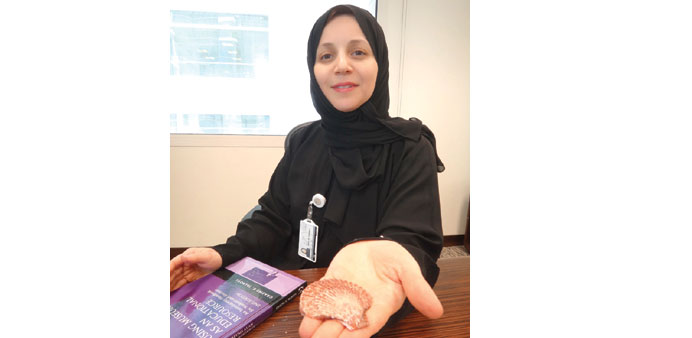
Another exceptional graduate with a passion for life-long learning is Nahil Salah al-Askari.
The 42-year-old Qatari earned a Bachelor of Arts degree in English Literature from Qatar University, and a Master’s degree in Educational Leadership from Qatar University, before deciding to embark upon a completely new career path.
Nahil recounts: “I’ve loved museums since I was a child, but when I started my career, the field of Museum Studies was not available here. I would travel with my family to Europe and my father would always take us to museums, so I developed an early interest and love for the subject.”
When UCL Qatar launched the MA in Museum and Gallery Practice degree in 2012, Nahil believed it would be an opportune time to pursue this interest.
Moreover, she had taken up a position at the Qatar Museums Authority (QMA) and received the support of the director, who encouraged her to continue her studies.
Today, Nahil is able to apply the knowledge she has gained to her daily work at the QMA.
She hopes the nation’s investment in museums will increase the community’s appreciation for art and nurture the informal education that is vital for the development of children and youth.