


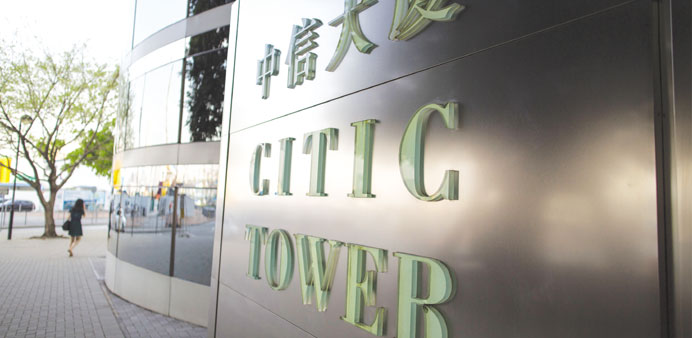
A woman walks past Citic Tower in the Admiralty district of Hong Kong. China’s President Xi Jinping’s plans to open the country’s state-owned enterprises to competition are spurring local officials to consider asset sales that could help rein in provincial and municipal debt.
China’s President Xi Jinping’s plans to open China’s state-owned enterprises to competition are spurring local officials to consider asset sales that could help rein in provincial and municipal debt.
Businesses controlled by local administrations, which range from hotels to retailers to power generators, had assets of 43.8tn yuan ($7tn) as of the end of March, according to ministry of finance estimates. The southern provinces of Guangdong, which has the biggest regional economy, and Guizhou pledged this year to look at changes in ownership structures for their holdings in coming years.
With the central government setting direction, such as through the transfer of assets at Citic Group Corp to its Hong Kong-listed unit, a “quiet wave” of stake sales by local authorities may come in 2015-16, according to Standard Chartered Plc. Productivity gains from revamping public-sector businesses would help China counter its investment-led slowdown.
“The movement on this has happened at a surprisingly fast pace,” said Andrew Batson, an analyst in Beijing at researcher Gavekal Dragonomics who has covered China since 1998. “Local governments have these huge off-balance-sheet debts, so they have a much stronger incentive than the central government necessarily does to try to raise cash from asset sales.”
Local SOEs span businesses from Kweichow Moutai Co, the Guizhou-based producer of baijiu liquor, to Jilin province-based China FAW Group Corp, which makes Audi and Volkswagen vehicles in China. There were some 98,554 locally-controlled state businesses at the end of 2012, according to ministry of finance data compiled by Gavekal Dragonomics, whose clients include Fortune 500 companies and hedge funds.
Shanghai may release a plan on changes to more than 50 SOEs in as soon as a month, Shanghai Securities News reported yesterday, citing an unidentified person.
Cities with “a good economic foundation and high-quality assets,” mainly located in the Yangtze River Delta and Pearl River Delta, are well-suited to use asset sales for debt reduction, Hu Yifan, chief economist at Haitong International Securities Group in Hong Kong, wrote in her 2013 book “Strategic Priorities: China’s Reforms and the Reshaping of the Global Order.” Successful sales would help counter a swelling in local authority debt to an estimated 17.9tn yuan, the consequence of the previous group of national leaders unleashing unprecedented stimulus to counter the 2007-09 global credit crisis. Xi and Premier Li Keqiang are now seeking to repair a fiscal system that starves local governments of tax revenue.
While Xi, Li and their Communist Party leadership team in November underscored the primacy of the state in the economy, they elevated the role of markets at the conclusion of an annual gathering. The shift has been followed by periodic signs of what’s shaping up to be the biggest revamp of public enterprises since Zhu Rongji in the 1990s gutted a swath of money-losing companies, helping fuel years of growth in excess of 10%.
Signs of momentum in restructuring state businesses include last month’s $36bn deal that will shift assets from Citic Group – China’s first state-owned investment Corp, set up in 1979 – to its main Hong Kong-listed unit.
China Petroleum & Chemical Corp, or Sinopec, has plans for what may become the nation’s biggest asset sale by an SOE. Private investment will be allowed in 80 projects from energy to infrastructure, the government said last month. The nation also plans to fold developers of military hardware into publicly traded state-owned firms, Bloomberg News reported last month.
A more broad-based retreat from public ownership at the central government level is unlikely, given the determination to keep the state sector as “dominant,” in the November Communist Party leadership statement.
“The core of the system is not going to change,” said James McGregor, Beijing-based author of the 2012 book “No Ancient Wisdom, No Followers: The Challenges of Chinese Authoritarian Capitalism” and Greater China chairman of advisory firm APCO Worldwide Inc. “They just want to make it more efficient, less money-wasting, less debt-ridden.”
Liberalisation of interest rates and natural-resource prices are among the other options to address inefficiency at the biggest state-owned companies. “President Xi will likely prosecute SOE reforms through market forces,” Stephen Jen, co- founder of SLJ Macro Partners LLP in London and a former International Monetary Fund economist, wrote in a note last month.
At the local level, authorities are poised to turn to revamping ownership structures as the pain from debt servicing increases, according to Standard Chartered’s Stephen Green in Hong Kong and Lan Shen in Beijing. “No one will choose to implement SOE reform voluntarily, but when the math no longer works, the number of choices dwindles,” they wrote in the report.