


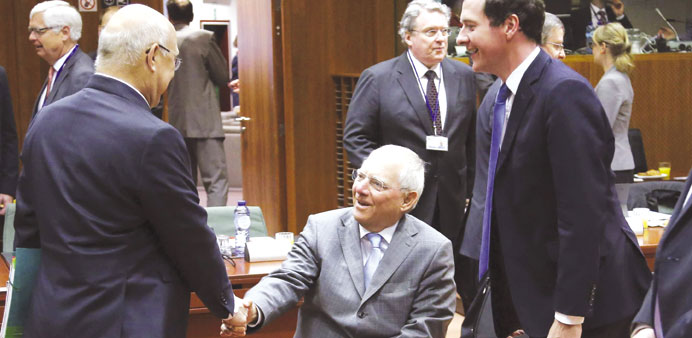
French Finance Minister Michel Sapin (left) greets German Finance Minister Wolfgang Schaeuble (centre) next to Britain’s Chancellor of the Exchequer George Osborne during a European Union finance ministers meeting in Brussels yesterday. France and Germany led a group of countries yesterday in calling for a tax on financial trading, but their failure to agree central elements of the plan means it will fall far short of its original ambitions.
France and Germany led a group of countries yesterday in calling for a tax on financial trading, but their failure to agree central elements of the plan means it will fall far short of its original ambitions.
The tax was promised in 2011 by German Chancellor Angela Merkel and then French president Nicolas Sarkozy as a means of getting banks to contribute more towards solving a crisis that had by then bankrupted Greece and Ireland.
Finance ministers from ten eurozone states made a further pledge yesterday to phase in the tax on the trading of shares and some derivatives from January 2016, two years later than the original start date.
But they left unanswered crucial questions such as how high the tax — opposed by a second group of European states including finance industry heavyweight Britain — should be and how it will be charged.
“We have ...a political agreement to go on with this,” Germany’s Finance Minister Wolfgang Schaeuble told peers in part of the meeting broadcast to journalists.
His French counterpart Michel Sapin hailed the pact as evidence that Europe was able to respond to the crisis, saying the levy would raise roughly €6bn ($8bn) annually from taxes on shares alone. This is nonetheless a fraction of the €35bn originally expected.
The European Green party’s candidate in EU elections, Ska Keller, who has also campaigned for the tax, dismissed yesterday’s agreement as unambitious. “It’s simply window dressing,” she said.
The tax resurrects an idea first conceived by US economist James Tobin more than 40 years ago. Its supporters view it as symbolically important in showing that politicians, many of whom have been accused of fumbling their way through the crisis, were tackling the banks blamed for causing it.
Ten countries — Austria, Belgium, Estonia, France, Germany, Greece, Italy, Portugal, Slovakia and Spain — signed yesterday’s statement underscoring their commitment to the phasing in of the tax.
But the alliance is fragile.
Slovenia, which also supports the project but whose government has collapsed, was unable to sign. European Union law requires nine countries to take part in order for the scheme to proceed.
“This is just a political statement,” Michael Spindelegger, Austria’s finance minister told peers of the plan. “We have found common ground. Not much common ground.”
As ministers met in Brussels, activists in favour of a levy that has also been dubbed the ‘Robin Hood’ tax — after the legendary English outlaw who robbed from the rich to give to the poor — acted out a boxing match to symbolise the fight over the levy.
In one corner, an activist dressed in green and wearing a quiver of arrows pretended to knock out his opponent, who was dressed as a banker in a suit.
“This is a fight between bankers and Robin Hood,” said Natalia Alonso, a campaigner at Oxfam. “We are saying that the money raised with this tax should go to fighting poverty.”
Reaffirming a commitment to the tax is also important ahead of European elections that are expected to see a rise in support for populist eurosceptic parties.
Many experts, however, expect the scheme to be quietly shelved afterwards because it is difficult to implement.
Ignoring warnings from the European Central Bank that the levy would backfire, Merkel and Sarkozy had initially sought to win support across the European Union before scaling back their plans, in the face of stiff opposition, to just the eurozone.
They had to make do with a shaky alliance of countries, some of which reluctantly signed up to keep Germany happy. Divisions remain within the group over how the tax should work, including between Paris and Berlin. The tax’s sketchy one-page blueprint, passed around the table of 28 ministers from the European Union, prompted a fiery debate, with Britain’s George Osborne accusing the Franco-German group of devising a scheme that would punish pensioners.
He said he would challenge it legally if it hurt Britain.
“The financial transactions tax is not a tax on bankers. It is a tax on jobs, on people’s pensions and on pensioners,” said Osborne, drawing a rebuke from Schaeuble that he was playing to the crowd of watching journalists.
But Osborne had support from Anders Borg, the Swedish finance minister and long-term critic of the project, who dismissed the plans for a “very inefficient and costly tax”.
It has been clear from early last year that the final plan will be scaled back. Under a re-drafted model described then to Reuters, the standard rate for trading bonds and shares could drop to just 0.01% of the value of a deal, from 0.1% in the original blueprint.