


AFP/Panama City
Conservative Juan Carlos Varela called for a national unity government after winning Panama’s presidential election, easily defeating President Ricardo Martinelli’s hand-picked successor.
Varela, Panama’s vice-president and a former Martinelli supporter, won a clear majority – 39% of the vote - Panama’s Electoral Tribunal said, with 80% of polling stations reporting.
Varela was the surprise winner in a three-way race.
The final results put him seven percentage points ahead of his nearest rival, Martinelli loyalist Jose Domingo Arias.
The new administration will be “a humane government, a government of consensus, a government of national unity,” Varela said in a victory speech to hundreds of supporters.
Varela also promised that politics in Panama “will change from being a business to a service,” he said, a reference to allegations of corruption under Martinelli.
During his campaign Varela also vowed to curb Panama’s 4% inflation by imposing price controls, a policy commonly associated with leftist governments.
The president-elect is a 50-year-old alcohol manufacturer, fervent Catholic and member of the conservative Opus Dei religious group.
Martinelli and the now president-elect had a bitter falling out in 2011, when Varela was fired from his job as foreign minister — which he held along with the vice-presidency — and Arias, a former housing minister and a businessman, was appointed instead.
The political scars have yet to heal.
“I know the candidate,” Martinelli said about Varela after the vote results were announced. “Lord have mercy on us.”
Arias promised “constructive opposition” as he conceded defeat. A third candidate, former Panama City mayor Juan Carlos Navarro, also conceded. One of Varela’s first congratulation calls came from Venezuela’s leftist President Nicolas Maduro.
Caracas and Panama broke ties in March, with Maduro slamming Martinelli as a corrupt US lackey, and Martinelli claiming that Maduro was trying to not pay $1bn owed to the Colon duty-free trade zone and to COPA, the Panamanian airline.
Maduro wrote on Twitter that he wished Varela “great success” in the name of the Venezuelan people.
“I hope to move towards an improvement of our relations,” he wrote.
Lawyer and political analyst Ebrahim Asvat said that whatever the outcome of the vote, the country’s course for the next quarter century already has already been mapped out.
Panama will continue to focus, he said, on free market policies that maximise economic expansion — the path forged by Martinelli, who served two five-year terms in office.
“Panama has made an extraordinary effort to open up its economy, exercise fiscal discipline and none of the candidates is going to veer from that path,” Asvat said.
The country enjoyed a blistering 8.5% growth last year, but economic inequality remains a problem, with about 26% of Panama’s 3.8mn residents living in poverty.
Panama has long linked its economy to shipping, trade and the trans-oceanic canal - currently undergoing a massive expansion to accommodate larger vessels - but increasingly is turning to mining, tourism and service industries such as catering to foreign retirees.
“Economic growth has benefited a small elite,” said Jaime Purcell, a political analyst focusing on Panama’s electoral process. “Regardless of who wins, there is not going to be major (policy) change.”
Not everyone is thrilled with the status quo. “Whoever wins, I still have to go to work,” shrugged Manuel Dominguez, a sidewalk merchant who makes his living selling batteries and TV remotes in the heart of Panama City.
Varela takes office on July 1 for a five-year term in office. Panamanian voters on Sunday also cast ballots for mayors and members of Congress.
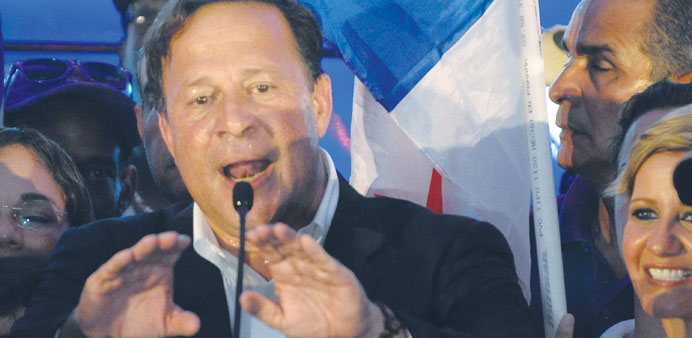
The new administration will be u201ca humane government, a government of consensusu201d