


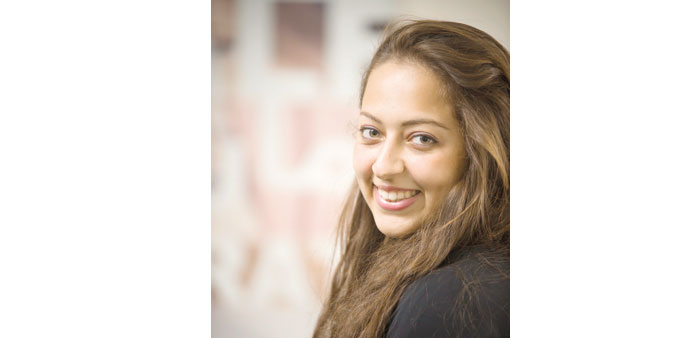
PAINSTAKING PORTRAYAL: Filmmaker Amal al-Agroobi has won hearts and minds with her stellar work.
What started as a film about music therapy and its role in managing autism snowballed into a much more powerful narrative — a glimpse into how families deal with their autistic children, writes Anand Holla
It was perhaps out of sheer desperation that Fauzia al-Ali, while writing to a friend about grappling with her six-year-old son Khalifa’s autism, remarked: “I wish somebody makes a film about my son.”
That friend forwarded the mail to another friend, Sharjah-based neuroscientist-turned-filmmaker Amal al-Agroobi, who leapt at the opportunity. “The idea fell into my lap. I knew I had to make this film,” al-Agroobi said.
As part of the Hekayat Khaleejiya series, which is dedicated to showcasing cinematic voices from the Gulf region, the Doha Film Institute, last week, screened al-Agroobi’s moving documentary feature The Brain That Sings at the Museum of Islamic Art auditorium.
The 50-minute film traces the journey of two autistic boys in the UAE — 19-year-old Mohammed and six-year-old Khalifa — and their progress over three months of music therapy.
Also screened was Qatar’s Jawaher al-Khater’s three-minute short film One In Five, which is about a mother trying to make a connection with her young autistic son. The night ended with an interesting discussion mainly between the directors and the audience, centered on this complex neurodevelopmental disability.
Even after she was done making her point on stage, al-Agroobi looked like she could talk for another two hours about her film. “I am excited to be here because thanks to my sharing of Mohammed and Khalifa’s stories, the audience is all the more wiser,” she told Community. “Earlier, they didn’t want to talk about it. Now they know exactly what parents of autistic children are going through. And that’s how change starts to come about.”
Winner of the People’s Choice Award at the Dubai International Film Festival, last December, The Brain That Sings focuses largely on the cultural and social stigma associated with raising a special needs child in the Arab world. It also makes a sincere attempt at understanding the emotional trauma such families go through when they chart out their children’s future.
Shot over three months, al-Agroobi and her crew would be down at Khalifa’s house on Tuesdays and Mohammed’s on Wednesdays, mostly while they would be receiving music therapy from Dubai-based Marion Tennant. “In the beginning, it was the toughest as it was difficult getting permissions to tell this story. People were reluctant to talk about it,” al-Agroobi said.
What started as a film about music therapy and its role in managing autism snowballed into a much more powerful narrative — a glimpse into how families deal with their autistic children. “When you make a documentary film, you need to have luck on your side,”
al-Agroobi pointed out, “You need to have lovable characters that can move your audience.”
It’s hard to dispute the likability of the two leads. Both Khalifa and Mohammed are not only lovable characters, but are also naturals at drawing audience empathy. While young Khalifa eventually gives in to the groove of musical instruments and starts responding more smartly to sounds, Mohammed takes all the time to start liking what he experiences around him. In the end, in both cases, improvement in self-expression is there for us to see.
“When I was conceptualising this film, a filmmaker told me: You will never be able to pull it off. Arabs don’t talk about their kids with disabilities,” al-Agroobi admits, “But I suppose I was lucky. I got good characters.” To lend a wholesome insight into how the Emirati society deals with autism, she has also included views of experts and autism centre authorities.
On mentioning about a lady in the audience weeping through the film, al-Agroobi found the reaction somewhat rewarding. She said, “It’s an emotional response. When my film manages to do that, I know that the message has really gotten through.”
That must also be because of how the film manages to convey the upheavals that the two families continually endure. Softly shaking his head, Mohammed’s father Saleh al-Tamimi said, “It’s unimaginably difficult to engage them in something, and even more difficult to disengage them from what they are doing. They don’t listen to you. They won’t do what you want them to do. But they will ensure that they get to do what they want to do.”
In the film, al-Tamimi comes across as an exemplary father, blessed with an endless reservoir of patience and inner strength to accommodate his son’s whims. Talking to al-Tamimi only confirms that perception.
“It’s an arduous journey because we go through days on end without an hour of sleep. Some days, Mohammed sleeps for 15 hours at a stretch, and on some days, he stays up for 36 hours on a trot. Somebody has to stay up all that while as he can’t be left alone,” said Al Tamimi, referring to his son’s epileptic history and propensity to have violent outbursts.
“I take him out every day and try to keep him interested, while my wife looks after his cleanliness and well-being,” al-Tamimi said. For the past 12 years, Mohammed’s caretaker, too, has been at the receiving end of his ire and mood swings.
“He pinches her, hits her, and yet she has never told us that she wants to return to her country. We are so fortunate to have her look after our son. That’s why every time she returns from her holiday, we give her a raise. It’s important to take care of your caretaker,”
al-Tamimi said.
Likewise with Khalifa’s caretaker, who is concerned for Khalifa more than she is for her own children back home, feels al-Agroobi. “She says she will stay with Khalifa until he becomes a doctor,” al-Agroobi said. The documentary does a neat job of bringing in this crucial aspect of tending to autistic kids.
Participating in the film was
al-Tamimi’s way of offering solace to other autistic children’s parents. “I wanted other families to know, and to feel that we are in this together,” he said, “We wanted everyone to see how we deal with this in the most natural way.”
That explains why al-Tamimi looks ever so composed in the film, as he walks his son through the streets — even as onlookers stare at Mohammed — or shares a meal with him at a restaurant. “If he gets too angry, I need to grab him and look deep into his eyes. Then he calms down,” al-Tamimi said.
For Fauzia, too, it has been an uphill task to deal with everything from financial problems to finding a school for Khalifa, after her husband passed away two years ago. “But she found it heartening to see the positive change in Khalifa, following the music therapy,” al-Agroobi said.
While it takes time and a lot of effort to alter social attitudes towards developmental disorders like autism, al-Agroobi is glad to be among those who initiate the process.
“I am a firm believer in social change. All my life, I have lived abroad. So when I returned to my country, the UAE, and saw the gap between what is and what’s left to be done, I felt I should be a part of it. If I could do that through films, a medium that I love, then even better,” she said.
Two years ago, the globe-trotting neuroscientist decided to take the cinema plunge. Last year, she set up ALAGROOBI Films. Her short documentary Half Emirati, on mixed parentage and its social effects, was well-received as well. To make The Brain That Sings, al-Agroobi turned to the hottest trend in the market for people with solid ideas — crowd-funding.
Through the crowd-funding website Alfamnah, she managed to raise US$15,000 for her film. “Since we want to travel all over the UAE and raise nation-wide autism awareness campaign by screening it in various schools and universities, we now have a crowd-funding campaign on Zoomaal. If possible, we would love to show the film across Qatar, too,” said al-Agroobi.
Possibly, the stickiest challenge Al-Agroobi faced with her film was after it was completed. “People are okay with you in the beginning, but once the story is out there, they tell you: We are not sure if we want to show this anymore,” she said, referring to those who backtracked from being part of the film.
“As a director, it makes your job hard. And as a tool with which you want to bring about some social change, it makes it all the more difficult because you want to ensure that everybody is comfortable,” she said.
Fortunately for al-Agroobi, everybody who mattered eventually embraced the film. Underlining the power of cinema to lend new insight, she said, “When Fauzia watched it for the first time, she was bawling. That’s because in the film, she saw things that Khalifa wouldn’t tell her, especially regarding his father’s death. Earlier, Khalifa wouldn’t express himself. Autistic children can’t express themselves anyway. So imagine if the child has to deal with an emotion like grief.”
BELOW:
1) ON SONG: A still from The Brain That Sings that shows music therapist Marion trying to engage Khalifa in a song.
2) HANDS-ON PARENTING: A still from The Brain That Sings shows Saleh al-Tamimi eating out with his son Mohammed.
3) INTERACTION: Amal al-Agroobi, first from left, and a panel during a discussion with the audience.