


AFP/Panama City
Voters in Panama went to the polls yesterday to elect a new president amid a seeming consensus in favour of the free market policies of outgoing President Ricardo Martinelli.
The campaign has gone down to the wire, with polls giving any of the three leading contenders a reasonable shot at victory.
The frontrunners — ruling party candidate Jose Domingo Arias, opposition politician Juan Carlos Navarro and Vice President Juan Carlos Varela — all cast their ballots soon after polls opened at 7am (1300GMT).
Four other candidates also are on the ballot.
A simple majority is needed to win with the victor taking office on July 1.
Turnout among Panama’s 2.5mn eligible voters, who are also tasked with electing dozens of mayors and members of Congress, was expected to be high “because there’s even greater interest” than usual,” said Erasmo Pinilla, head of the country’s election authority.
Martinelli, speaking from the presidential palace yesterday urged Panamanians to “vote for whomever you want, but vote.”
Those remarks notwithstanding, Martinelli has been an outspoken supporter of Arias, 50, the country’s former housing minister and a businessman who made his fortune manufacturing ladies’ undergarments.
Representing the Democratic Change party, Arias’s running mate is Marta Linares, Martinelli’s wife.
Navarro, 52, the candidate representing the centre-left Democratic Revolutionary party, was formerly mayor of Panama City. He has vowed to crack down on crime and to do more to protect the environment.
Trailing the other two candidates by a handful of percentage points is Varela, 50, a liquor manufacturer who is Martinelli’s current vice president, but now is seen as his political enemy.
The two had a falling out after Martinelli dismissed Varela as his foreign minister in 2011, opening a political wound that has yet to heal.
Lawyer and political analyst Ebrahim Asvat said that whatever the outcome of the vote, the country’s course for the next quarter century already has been laid out.
Panama will continue to focus, he said, on free market policies that maximise economic expansion — the path forged by Martinelli, who is leaving office with a 67% approval rating.
“Panama has made an extraordinary effort to open up its economy, exercise fiscal discipline and none of the candidates is going to veer from that path,” Asvat said.
The country enjoyed blistering growth of 8.5% in 2013, but economic inequality remains a major concern, with about 26% of citizens living in poverty. Those patterns of economic distribution have only been reinforced during the current boom, and that is unlikely to change, experts said.
“Economic growth has benefited a small elite,” said Jaime Purcell, an political analyst focusing on Panama’s electoral process. “Regardless of who wins, there is not going to be major change” in policy, he said.
Luis Herrera, a Panama City electrician, said the Martinelli era has been good for the country, and that he plans to vote for the president’s pick Arias.
“We can’t go backward,” he said. “Panama has made great strides these past few years thanks to this government, and I hope that we will continue on the same path.”
Not everyone is thrilled with the status quo, however. “Whoever wins, I still have to go to work,” shrugged Manuel Dominguez, a sidewalk merchant who makes his living selling batteries and TV remotes in the heart of Panama City, the capital.
Dominguez grumbled about rising prices, even though inflation in Panama is a relatively modest 4%. “Everything is super-expensive,” he said adding that he’ll vote for Varela, who has vowed to curb inflation by imposing price controls, a policy commonly associated with the left.
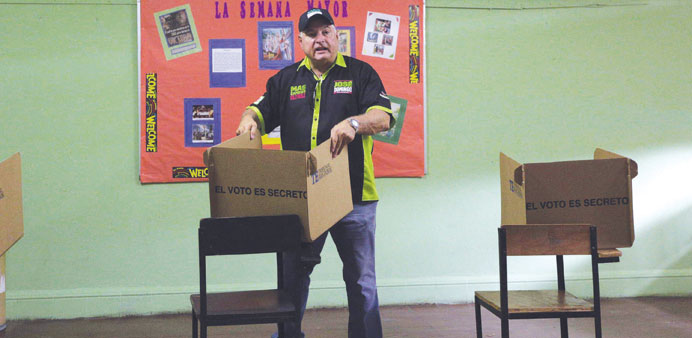
Panama President Ricardo Martinelli moves a voting screen to have some privacy while casting his vote in Panama City yesterday.