


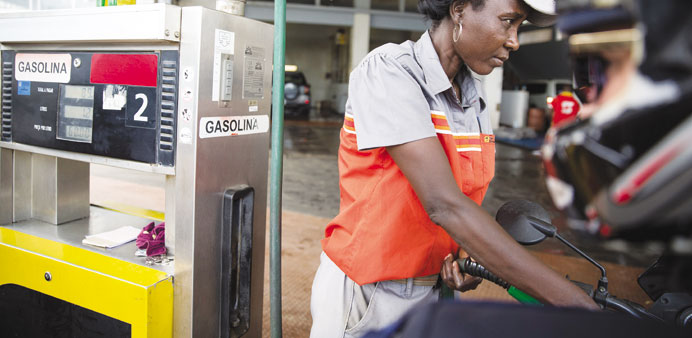
A Sonangol gas station attendant fills a vehicle with gasoline at a petrol pump in Luanda. The state-owned Sonangol recently announced an $8bn investment programme.
Despite colossal investment, Angola’s goal of pumping two million barrels of oil a day and even upstaging Nigeria as Africa’s largest producer remains a pipedream.
To be sure, Angola’s oil industry is going gang-busters.
State-owned oil firm Sonangol recently announced an $8bn investment programme and began to flog ten on-shore concessions.
Total is slated to invest $16bn, while other global energy companies ENI, Statoil and ConocoPhillips also have plans to put more work boots on the ground.
This has led officials to predict, again, that the country will break the symbolic production level of two million barrels a day and that it could even get within striking distance of Nigeria’s 2.5mn a day rate.
Angola is keen to reach that level of production because, as well as two million being a nice round number, it would represent a significant boost for Africa’s third-largest economy.
The black gold lying off the coast of the capital Luanda and the Cabinda enclave accounts for 30 to 40% of economic output and around 80% of government income.
Oil wealth has made many insiders rich, but has also been used to fund reconstruction since a devastating civil war ended in 2002.
And yet, the faster Angola pumps, the further it seems from its target.
Industry insiders say a mix of technical problems, infrastructure bottlenecks and state intervention means any attempt to retake the title of Africa’s largest oil producer, which Angola briefly held in 2008, is likely to end in failure.
Last year crude production fell 1.1% to 1.71mn barrels a day, a disappointing showing after a 4.5% jump the previous year.
That raised the ire of Sonangol’s chief Francisco de Lemos, who demanded “explanations” from the heads of Chevron, Total, Esso and BP about a series of problems that contributed to the drop.
Maintenance work, mechanical damage and delays in delivering technical equipment have all taken their toll.
Foreign operators complain that the delays often stem from Sonangol’s insistence that it gives final approval to any construction or technical work.
Amid the mudslinging, Fitch has downgraded Angola’s credit rating outlook from positive to stable, a move that could make foreign investors more cautious.
“Expanding the hydrocarbon sector has proved more challenging, compared with what was expected,” the ratings agency said.
But geology is also a factor in the decline.
Angola’s expensive-to-drill “ultra-deep” blocks and the “maturing” shallow-water concessions will limit production, according to Alex Vines of UK-based think tank Chatham House.
Fitch estimates Angola’s output is declining at a rate of around 200,000 barrels per day, each year.
“It will be difficult for Angola one day to overtake Nigeria, which has much larger reserves and currently superior production capacity,” said independent consultant Jose de Oliveira.
While new discoveries will push Angola’s reserves beyond its current proven reserves of 12.7bn barrels, that still lags far behind Nigeria’s 37.2bn.