


|
By Anand Holla
Purely for its premise, Elena is a cinematic dream. Two decades after her actress sister Elena leaves home, young Brazilian actress Petra Costa goes to New York in search of her. Costa, however, has internalised Elena to a point that she doesn’t know where she ends and Elena begins. |
Even if Elena was fiction, it’s a spectacular story. But what adds to its aura is that it’s a documentary, directed by Costa with sensitivity only such an intensely personal account could provide. As part of the Doha Film Institute (DFI) Brazil Cinema Showcase, Elena was screened at the Museum of Islamic Art Auditorium last waeek to a near full house.
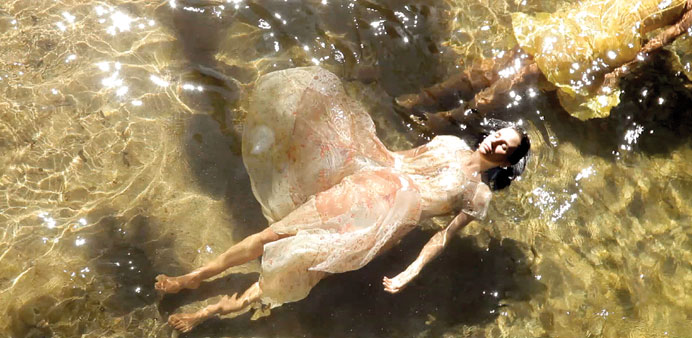
The 80-minute journey into Costa’s mind, memories and musings begins with a dream. Unlike how films often exploit dream sequences to introduce drama, this one is for real – Costa had this dream. Elena in on top of a wall, entangled in a mesh of electrical wires, and then it is Costa. When Costa touches the wires, the electric shock hurls her to the ground and she dies. Costa wakes up, but Elena doesn’t.
Elena can’t because she, as a 20-year-old runaway actress, died in 1990. How and why is what you discover much later. Costa was only seven then. Refusing to let go of her sister, she made a place inside her head for her to live, or at least flit by. So when Elena opens her eyes within Costa, the latter says, “I feel you in me.” Does Costa, deep within, feel Elena’s death as well?
It’s hard to tell as the film unravels, exploring layer after layer of complexity. Elena is a troubled soul who nurtures the same dream as her mother once did — to become a movie star. She goes to New York, forsaking a childhood spent in hiding during the years of the military dictatorship. When Costa grows up and becomes an actress, she takes along newspaper clippings, a diary, some letters, and home movies, and goes to New York “in search of Elena.”
This search is what sets Costa’s documentary apart. You never know whether Costa is in touch with reality, or is willing to accept it. Also, their mother’s struggle with understanding why Elena did what she did, and in ensuring Costa grows up well after surviving a troubled childhood, is a heart-rending track. When Costa turns 21, her mother says, rather poignantly, “Now, you are older than Elena.”
Perhaps unintentionally, the film also becomes an ode to cinema itself – three generations of women inspired and affected by the power of films. Costa certainly has emerged a winner in the long run. Apart from Elena, which bagged the top awards at the 2012 Brazilia Festival, Costa made Undertow Eyes, an award-winning short film that explored ageing and love, as seen through the eyes of her grandparents.
It’s not just the simmering tragedy of Costa’s family’s story that grips you; it’s as much Costa’s poetic treatment. Time and again, there are fuzzy, out of focus shots of a woman lost in a big city, or candid home video clips tracing a childhood unaware of the devastation that was soon to befall the family.
The minimal but powerful use of background music, and even the fluid editing are some of the many elements that Costa gets spot on to elevate a personal story into a space beyond it. As the film ends, one can’t help but think what kind of catharsis it must have been for Costa to piece together this documentary over the years, revisiting many a memory she wouldn’t have wanted to.