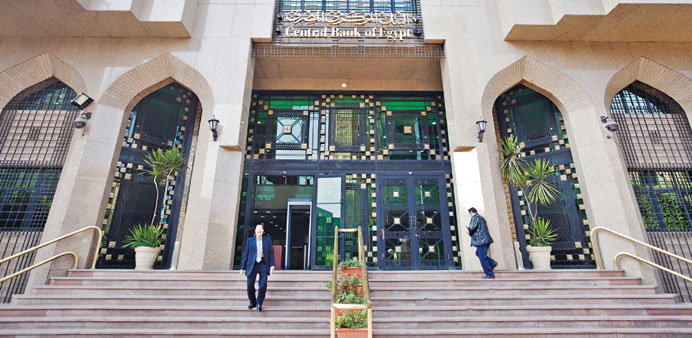
Pedestrians use the stairs outside Egypt’s central bank in Cairo. Egypt’s share of the estimated $1.7tn in current global Islamic banking assets remains negligible.
Bloomberg/Cairo
Egypt’s biggest Islamic loan, signed last Monday by Al Nouran Sugar, is adding to evidence borrowers are turning to Shariah-compliant funding in a country that ousted its Islamist government less than a year ago.
The company signed a 1.5bn Egyptian-pound ($215mn) loan to build a factory, according to Al Nouran’s chief executive officer Ashraf Mahmoud. That topped Egyptian Steel’s 1.1bn-pound facility, which was the North African country’s biggest Islamic loan when it was agreed six months ago, according to data compiled by Bloomberg.
Islamist president Mohamed Mursi was overthrown in an uprising in July, derailing plans for a debut sovereign sukuk sale from the most populous Arab state and stalling the development of its Shariah-compliant financial regime. Borrowers are using Islamic funding options to tap an industry growing at 17% a year and set to be valued at $2.7tn by 2017, according to PricewaterhouseCoopers.
“The perception of Egypt is changing with political risk coming down,” Montasser Khelifi, senior manager for global markets at Dubai-based Quantum Investment Bank, said by phone on Monday. “For Egyptian borrowers, it allows them to tap into Gulf Co-operation Council funds since there are some institutions here that only deal in Islamic financing.”
Banque Misr, along with the local units of Lebanon’s Bank Audi and Abu Dhabi Islamic Bank, were the lead arrangers for Al Nouran’s 8.5-year deal. The loan was priced at 4.25% more than the Egyptian “mid-corridor” rate, which is half way between the overnight deposit and lending rates and currently stands at 8.75%, Mahmoud said.
Local-currency Egyptian government bonds due April 2022 are yielding about 16%, according to data compiled by Bloomberg.
The company also agreed a $30mn mezzanine facility, or debt that is convertible to equity in case of default, from the Islamic Corporation for Development of the Private Sector, a unit of Jeddah, Saudi Arabia-based Islamic Development Bank, according to Mahmoud.
“We saw that ICD is a AAA-rated institution with a firm commitment to invest in Egypt,” Mahmoud said by phone on Monday. “They were the first on board and we had no problem with Islamic financing so it made sense to accommodate them.”
Egypt’s share of the estimated $1.7tn in current global Islamic banking assets remains negligible. There are three fully Shariah-compliant banks in Egypt with combined assets of about 80bn pounds, according to data compiled by Bloomberg, or less than 5% of the country’s total banking assets.
The country’s plan to issue Sukuk during the one-year presidency of Mohamed Mursi never materialised after the military seized power.
Thirteen Egypt-based banks took part in Al Nouran’s financing for the plant, which will be built in the Sharkiya province of the Nile Delta and produce 500,000 tonnes of sugar annually. ICD and Kuwait-based Arab Fund for Economic and Social Development also bought $25mn equity stakes each, Mahmoud said.
“We may be seeing a landmark deal that opens the door for other corporates to consider this kind of financing,” Khelifi said.