


Reuters
A Palestinian unity deal will not lead Islamist group Hamas to recognise Israel’s right to exist and will not result in any Gaza militants coming under President Mahmoud Abbas’s control, a senior Hamas official said yesterday.
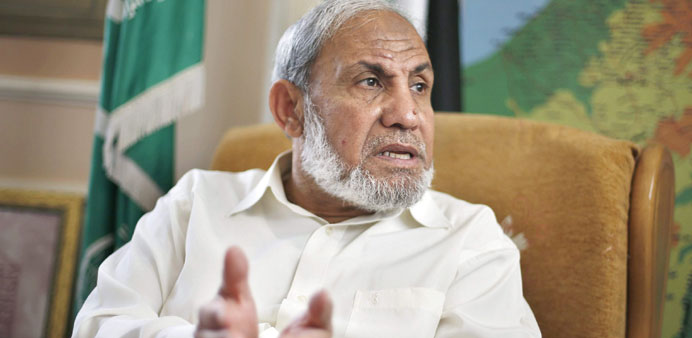
Veteran Hamas strategist Mahmoud al-Zahar told Reuters the group, which runs the Gaza Strip, was waiting for Abbas to form a unity government, but said the Palestinian leader was taking his time in an effort to overcome US and Israeli opposition.
Hamas, which is viewed as a terrorist group by many Western capitals, unexpectedly agreed with Abbas last week to lay aside old animosities and create a transitional cabinet paving the way to long-overdue elections across the Palestinian territories.
The reconciliation accord angered Israel, which promptly suspended floundering peace talks with the Western-backed Abbas, saying it would not negotiate with any administration backed by Hamas.
Zahar, who is one of Hamas’s most influential voices, said Abbas only decided to seek unity because the US-driven negotiations were leading nowhere, but predicted he would take his time trying to assemble a government of technocrats.
“He is trying to overcome a great wave of pressure. We are waiting,” said Zahar, adding that Hamas had already handed across lists of names of possible ministers.
Hamas’s elder statesman, who has had spiky relations with the group’s leadership, said Abbas was using the unity deal to put heat on Israel, but that he was also worried by a US threat to suspend hundreds of millions of dollars in vital aid.
“He is seeking a guarantee that US financial support will continue,” Zahar said, speaking from his well-guarded house.
Looking to reassure Western allies, Abbas said the new government would recognise Israel and honour previous treaties. Zahar dismissed this as a hollow gesture, saying the ministers would be academics with no political authority.
“Abbas is not telling them the truth. He says ‘this is my government’. But it is not his government. It is a government of national unity. He is marketing it in this way to minimise the pressure,” said Zahar, who took part in the unity negotiations.
The unity pact follows a trail of previous, failed efforts to overcome the deep schism that has traumatised Palestinian politics. Agreed in just a few hours, it sidestepped one of the most sensitive issues - who would be in charge of security.
Hamas’s armed wing has some 20,000 men in its ranks. Abbas has his own, Western-trained forces, that often co-operate with Israeli troops and police in the nearby West Bank - a practice that Zahar called “shameful”.
Zahar said Hamas would remain in charge of its own troops regardless of the latest deal and irrespective of who won national elections, slated for later this year.
“Nobody will touch the security sections in Gaza. No one will be able to touch one person from the military group. Nobody asked for that,” he said, sitting next to a photograph of one of two sons who were killed in Israeli attacks.
Hamas won the last legislative elections held in the Palestinian territories in 2006 and then seized control of Gaza after ousting forces loyal to Abbas a year later.
It appeared to be on the ascendance when fellow-Islamists were elected to office in neighbouring Egypt, but its fortunes crumpled following last year’s military coup in Cairo.
Hundreds of smuggling tunnels connecting Gaza to Egypt were destroyed.
Zahar said divisions in Egypt were a “catastrophe” for the region. He also acknowledged that once deep ties with Iran had not fully recovered after Hamas had refused to back Syrian President Bashar al-Assad in his ongoing civil war.
“We have a good relation (with Iran), but you know the impact of the Syrian problem is still a factor. ... The communication is not as it was,” he said, declining to give details of Iranian funding for Hamas.
Some political analysts said Hamas’s international problems had spurred it towards reviving the reconciliation pact. But Zahar said Abbas, whose mandate expired five years ago, had made the overture because peace talks with Israel were at a dead end.
“He is very weak,” said Zahar.