


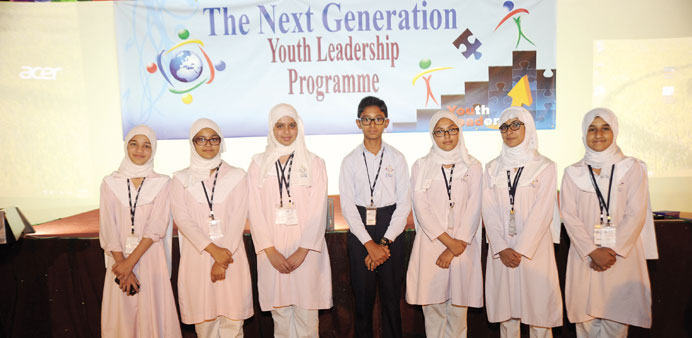
HOSTS: Students who conducted and co-ordinated the entire programme.
Students from multiple schools learn about leadership at TNG School
More than 160 students got a chance to be part of the Youth Leadership Programme conducted by the The Next Generation (TNG) School in Doha recently.
Designed around drills and skills, the TNG programme aimed at fostering leadership abilities in today’s school children, the future leaders, from a very young age. It allowed them to try and test their abilities through competition, besides learning from experiences of some of the best in current generation.
The second TNG Youth Leadership Programme was a three-day event that hosted inter-school competitions and workshops by distinguished speakers.
“I have been to TNG before and the level of intelligence, the capability kids have shown here has always amazed me. Such occasions give you the opportunity and the confidence to come forward and express yourself,” said Badar Sohail Khan, HR Advisor to Ashghal Public Works Authority, while speaking at the concluding ceremony. He was the first presenter of the YLP and his presentation had the message of dreaming big.
The programme featured a leadership workshop in which renowned speakers from Doha spoke about the behavioural development and skills of young budding leaders.
More than 168 students (age group 8-14 years) from different schools of Doha registered to attend the event. Pakistan Ambassador Shahzad Ahmad was the Chief Guest. Dr Javaid Sheikh, Dean of the Weill Cornell University of Qatar chaired the event, while Riyaz Ahmed Bakali, the Founding Director of TNG Group, and Principal Qudsia Asad Khan were also present.
From the beginning to the end, the event was entirely conducted by the students. Ten students, with Mahrukh Bakali and Fatima Rizwan in the lead, co-ordinated and conducted the entire programme.
The first day of the YLP was for children aged 3-5. It was all about rhymes, allocution and poems bringing out the talent and confidence of the youngest. Students of Rising Star Kindergarten, Middle East International School, Doha Modern Indian School and TNG participated in solo and group performances.
Next day, children aged 5 to 8 years participated in the activities involving exercises to enhance creative skills, analytical abilities, public speaking skills. Students from Pakistan Education Centre, Middle East International School, Doha Modern Indian School and TNG participated in essay and story writing, drawing competitions and debate on whether Internet is good or bad.
Badar Sohail Khan, in his presentation, said, “One characteristic of leadership is communication. Talk in such a way that people would like to hear you and hear in such a way that they would like to talk to you.”
He shared with the children the names of some Pakistanis who featured in the world’s top 10 intelligent people’s list in 2012-13: Moosa Feroz, a math ambassador; Ali Moeen Nawaz, who scored 23 A’s in his A level exam; Arfa Karim (late), youngest Microsoft Certified Professional; and Farhan Masood, a student of MIT.
“The most important thing is that you need to set goals and objectives for yourself,” he said.
Timur Shah, an Events Division Manager at G4S and ex-army officer, came in next to train the children on leadership abilities. He highlighted the social, ethical and religious aspect of leadership. His session was interactive and based on question and answers.
“A leader leads with focus. He is kind and brave showing love and compassion towards his team and is truthful. He is straight forward and talks about what is right,” Shah told the young students.
Talking to the parents and teachers, he quoted author L R Knost: “We talk about leaving a better world to our children, but we forget about leaving better children for our world.”
Dr Shaukat Chandna took the stage by storm, engrossing the young attendees with his stories and leadership experiences. The foremost quality to acquire for any leader, Chandna said, is tolerance.
Sharing the story of the Greek mythological host Procrustes, who use to adjust his guests according to the size of his bed, he said that “we try to force other people into our way of thinking by any which way instead of understanding them.”
The world, he concluded, is thus not created for “softies”. He said, “This world is created for people who would grow up and fight their way through.”
Hassan Imam, a renowned HR professional, spoke about goal settings and objectives. He shared with the young leaders the success story of the famous Shaukat Khanum Memorial Hospital and the legendary cricketer-turned-politician Imran Khan. “A leader has to be determined, focused and has to understand requirement of what is expected of him,” he told them.
Shahzad Ahmad, Ambassador of Pakistan, congratulated the TNG management for organising the programme. Talking to the children, he said the society depends on the abilities of leaders and how well they can do their jobs.
“A leader is someone that many people look to for direction, guidance, and inspiration. So it is important for our leaders to have the aptitude to make difficult decisions and to know and do what is right for the people,” he told the audience.
“A higher authority is crucial for supervising and regulating others as well as being an example of a hard and dedicated worker. An effective leader has character, competence, compassion, courage and ability to work with the team,” Ambassador Ahmad told the students.
Dr Javaid Sheikh, Dean of Weill Cornell University in Qatar and the chairman of the programme, talked about the psychological aspects of leadership. Explaining the relationship between leadership characteristics and mind, Sheikh gave the children some tricks to train their brains for better leadership qualities.
“One of the characteristic of a leader is that he is a risk taker. How can you prepare yourself to make it a lifelong habit? Make it your second nature to take risk and show courage if you want to be a leader,” said Sheikh.
About increasing their intelligence quotient, Sheikh advised them to constantly perform mental exercises. “Learn as much as you can, read as much as you can and cut down on sugar,” he told the young students, saying that eating too much of sugar at young age is hazardous for IQ development.
Another characteristic of leadership is team work. This is the future of leadership. The future leaders are those who will influence others and make an impact, he added.
“What we see in future is something totally different from today. Plato said long ago that don’t teach your children of what you have learned. Indeed they are born for a different era than yours,” said Sheikh.
“One important aspect is learning to learn throughout your life. It does not matter what the facts are today, because they will change, we will change, science will change. Science itself will prove them wrong. As long as you know how to learn to acquire new knowledge, you will always achieve,” he added.
Sheikh said earlier people used to memorise most of the facts, which they would forget with time. He said memory is like a storehouse or a library, where every new information we learn is stored in some part. “You put a memory in there and you forget about it 2 to 3 weeks later. Later, you can take it out from there like a book,” he explained.
But a memory doesn’t always work that way. Unless you share or talk about the new fact you have just learnt, the emory will be locked away in your brain forever. “Unless you store it properly, you will not be able to get it back,” Dr Sheikh said.
The ending ceremony was all claps as it involved prize distribution for the winners and runners-up of the competitive events.
BELOW:
1) GUEST OF HONOUR: Pakistan Ambassador Shahzad Ahmad was the Chief
2) POWER OF STORIES: Dr Shaukat Chandna engrossed the young attendees with his stories and leadership experiences.