


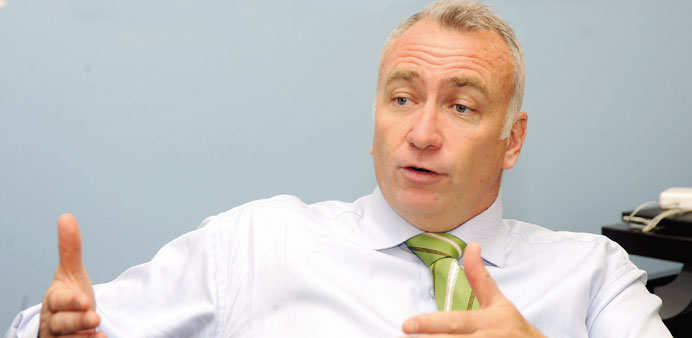
THE WAY FORWARD: Principal Mark Leppard at his office in Doha College, Al Waab campus. Photos by Shaji
By Anand Holla
Doha College may be one of the oldest British curriculum schools in Qatar, but its flair for keeping up with the times and adapting to newer challenges is perhaps why the institution is at the top of its game today.
34 years on, Doha College (DC) in its Al Waab and West Bay campuses, has 1,500 students between the ages of three and 18 representing more than 50 nationalities. As it prepares to leap into its state-of-the-art campus in Abu Hamour in 2016, Principal Mark Leppard talks to Community about running the show.
What has been the biggest change that Doha College has seen this year?
We have moved over to the iPads since September. All our students have them. The challenge though has been to facilitate e-textbooks for these devices as there aren’t as many in the UK as we need. While some of our departments can get them, not all can. We are liaising heavily with the exam boards and the publishers back in the UK to try and get more e-textbooks there, so we too can switch.
Which classes have access to iPads, and how tough was it to put this in order?
From three to 18-year-olds, every student has an iPad. All the staff and teachers have them. Mine is on the desk here (points to a new piece). We conducted a lot of training, and that has been the key to the success of its implementation. Also, the school pays 50% for the iPads. So we have put a significant financial contribution into that. Training though was the biggest element, and all staff, students and parents were trained. We are all connected on a wireless network now, and we intend to develop our own app in the next year or so.
How does the amount of usage and reliance on these devices differ for students across classes?
It’s really up to the staff to decide how they want to use and integrate it. It’s not used all the time. The iPad is not meant to replace the teacher. It’s just another tool. Our biggest and the most important resource is the teacher, who now has a terrific tool to teach better.
Has the response been good?
Yes, it’s been great. Initially, there were challenges as there are with any new initiative. Our second phase was meant to kick off in September 2014. But this has been so successful that we rolled it out this January instead. Our third phase will now be brought forward a year, to September, this year.
So are assignments being submitted and lessons discussed over this digital platform?
Of course, but that’s for the teacher to choose. Obviously, for formal exams, we have to follow the exam board’s protocol.
Have the parents been largely favourable of this move?
We have had parent workshops and the questions from parents have made this process smoother. We had parents asking us to help them understand this switch, support them through this, and whether their child should be doing this. We want and value that interaction. We don’t want it to be: Here’s an iPad, now go off and deal with it. Probably the biggest challenge has not been the students, but the parents and the staff understanding it. The children have been brought up on these devices. It’s a norm for their generation.
Have you considered the risks involved in relying too much on the digital devices, to which the children tend to get fixated on?
I don’t think any teacher teaches purely with an iPad. On Monday, I walked around our new West Bay campus for two hours. I visited every class and only three out of 25 classes were using it. So it’s just another tool. Just because we have it doesn’t mean everything has to be taught through it.
How are the plans for the Abu Hamour campus coming along?
Our architectural plans are finished to the concept stage, and we are ready with our presentation for the municipality. We have started to interview construction companies as well. So the project is progressing well.
Take us through some highlights of the new campus …
It will have all purpose-built classrooms, and fantastic sports facilities on the roof, apart from a 50-m swimming pool, indoor sports facilities, two sports pitches, purpose-built canteen and restaurant facilities. Our auditorium will hold an audience of around 600, and we will have underground parking with around 500 spots so as to make judicious use of space.
While planning this through, what is the central idea you have stuck to?
We want to take across the ethos of this school. You can have a new, swanky building, but if you don’t have the right ethos, it doesn’t matter what the building is. Our ethos is that the students should have holistic education with a strong academic base. Academia is the bedrock of our school.
So by holistic education, you want them to be well-rounded individuals?
Definitely. We want our students to be involved in the extra-curricular, you know, debates, sport, music, drama, photography, all of them. So when they apply to a university, what will make them stand out is that apart from great grades, they also have the other elements. For us, it’s about making our students well-prepared; from today’s learners to tomorrow’s leaders. We call it the DC experience.
What is your approach to parents-teachers interaction?
I don’t think the institution can ever over-communicate. It’s about getting the parents, students and the college working together in a tripartite relationship. The only way to do that is by communicating effectively with parents. My philosophy is that any parent, teacher or student can meet me.
I might not have the answers, but by talking, we can find the answers together. Our organisation Friends of Doha College which is about bringing the parents together has been successful too.
How tough is it for you to manage the institution?
Fortunately, my team is really strong. I have a fantastic Board of Governors, the British Embassy is hugely supportive, and also the ambassador and the representative on the board are superb. I also have an excellent leadership team, who are fiercely loyal and committed to ensuring that DC can be the best it can be.
My staffs are incredible hard-workers. We want to be one of the leading international schools in the world, and we have been classified as outstanding by various bodies. But excellence isn’t a destination. You never stop. We have to keep adapting and improving so that we keep getting better.
BELOW:
STANDING TALL: The Doha College campus in Al Waab.