


AFP/Reuters/Ljubljana
Political turmoil returned to Slovenia yesterday after Prime Minister Alenka Bratusek lost the party leadership following 13 months in office that saw bailout fears ease in the small eurozone member.
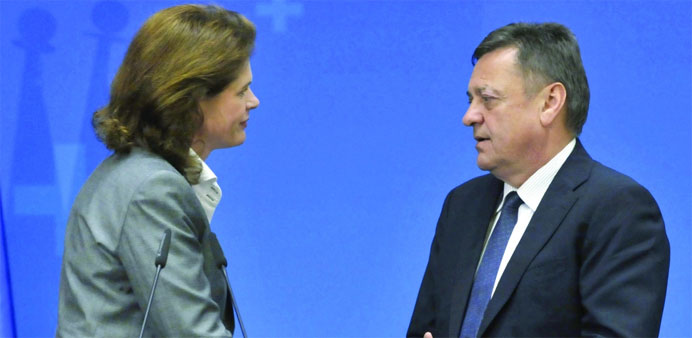
Bratusek, 44, was defeated in a vote in the early hours of yesterday at a congress of the ruling Positive Slovenia (PS) party, by its founder and Ljubljana mayor Zoran Jankovic, by 338 votes to 422.
Slovenia's first female premier had warned ahead of the vote that she would resign if this happened, saying: "Without the support of my own party, I can no longer be the head of government.”
It was unclear yesterday however what her next step would be.
Sources close to the party said that Bratusek will reveal her next steps on Tuesday.
The sources did not say whether Bratusek would resign or attempt to continue as prime minister, but her coalition partners and analysts said her resignation was the most likely option.
"Realistically she does not have other options but to resign," said Meta Roglic, a political analyst at daily *Dnevnik, adding that would lead to elections in September or October.
The office of President Borut Pahor tweeted that he would receive Bratusek on Tuesday.
Her three coalition partners all said yesterday that the present government could not continue and that snap elections should be held without delay – a call echoed by the opposition.
"This coalition has stopped existing," the leader of one of the coalition parties, Igor Luksic of the Social Democrats, told reporters. "With the election of Jankovic the time of this government is over.”
"The election of Zoran Jankovic is ending the term of this government," Karl Erjavec, head of the Pensioners' Party, another coalition partner, told the state news agency STA. "Snap elections are the only way to resolve this political crisis.”
Under Jankovic, the PS came first in snap elections in December 2011, but he failed to form a coalition and the centre-right Janez Jansa became prime minister instead.
Corruption allegations against both men led to the collapse of Jansa's government and to Jankovic resigning as PS head in favour of Bratusek, who formed a new centre-left administration.
Yesterday Jankovic, who has criticised the direction the party has taken in government, said that he would like Bratusek to stay on as prime minister.
"I would like us to leave this room more united than we came," he said, calling the weekend "a chance for reflection" and urging Bratusek "not to take any decisions".
"As long as we stay united, we can be a force of hope for Slovenia," he said.
Once a model newcomer to the European Union and the eurozone, the former Yugoslav republic of 2mn people, and in particular its banks, was hit hard by the global financial disaster of 2008-09 and the subsequent eurozone debt crisis.
But in her time in office, Bratusek has managed to satisfy Brussels that Slovenia does not need a bailout by pumping more capital into the banks and with a programme of privatisations and reforms.
Jankovic, a charismatic supermarket millionaire, said that the government was doing too little to restart the economy, but Bratusek said she had to compromise with her coalition partners.
"Politics is about nurturing fragile relations in order to build trust with partners that results in progress," she said.
If Bratusek resigns, Slovenia's President Pahor, political parties and parliamentary members will try to agree a new candidate for prime minister, a process likely to take several weeks and expected to end in failure. Only then can a new election be scheduled.
Analysts expect elections would stall key reforms which were designed to reduce the budget deficit to 4.2% of gross domestic product this year, in line with EU demands and down from 14.7% in 2013 when the deficit soared due to state injections in local banks.
"This is a serious risk to political stability ... and ongoing efforts to resolve the significant economic challenges facing Slovenia," said Timothy Ash, an emerging markets analyst at Standard Bank.
He expects a "significant negative" market reaction tomorrow, after yields on Slovenia's 10-year benchmark bond jumped to 3,698% on Friday from 3.562 a day before, according to Reuters data.
Jaromir Sindel, an economist at Citi Research, said if an early election is going to be held it should take place as soon as possible.
"If the eventual election takes place before the summer, it would be better for Slovenian credit as the new government could be ready for important decisions in the second half of 2014 – the (preparation of the) state budget for 2015 and privatisation issues," he said.