


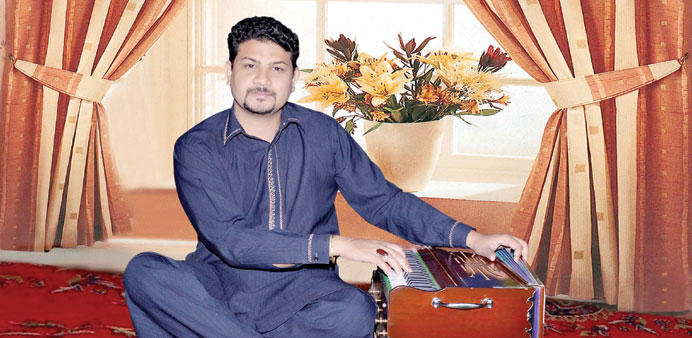
The tradition of ghazal singing in the subcontinent is fading by the day.
But exponents like Tahir Pervez Mehdi, from Pakistan, is keeping it alive
By Umer Nangiana
From selection of poetry and composing music to rendition, Tahir Pervez Mehdi has spanned all the faculties required for the centuries-old tradition of ghazal singing. Hailing from Pakistan, Tahir’s melodious voice has been trained by legendary ghazal singer Late Pervez Mehdi. It is his kind of voice that ghazal has always sought. Performing at a musical night in Doha organised by Punjab Music Group, Tahir showed great promise. “I like singing ghazals and I feel I have this responsibility of carrying this genre of music forward,” Tahir told Community.
Ghazal, in its style of singing and content, is a difficult genre to master as it involves an extraordinary expression. Not every singer can sing it. It takes proper training and years of practice before a ghazal singer can dare come out in public. Mehdi has all of it and that too from the masters of the art.
At a time when most youngsters would prefer more commercially viable pop genre of music, Tahir boldly selected ghazal as his choice before going on to learn and master it.
“It is in my family but nobody had professionally performed. Pervez Medhi was also my distant relative so my father took me to him when I showed interest in singing,” said Tahir. “For a complete year I kept watching and listening to him before Pervez Mehdi formally took me as his disciple,” he added about his lessons in ghazal singing.
Pervez Mehdi, who passed away in 2005, was one of the ghazal greats of the subcontinent. Mehdi himself had learnt the art from one of the giants in the field, Mehdi Hasan.
Tahir formally began singing in 2007, two years after this teacher’s death. “My family and friends encouraged me to start singing. I had not imagined it during Mehdi Sahab’s life as I was keen on learning then,” said the young singer, adding he also has interest in folk and playback singing.
For playback singing he is seeking guidance from the renowned Attray family of Pakistan. Zulfiqar Ali Attray, who has some great compositions to his credit, is teaching him the finer aspects of playback singing, he said.
“Film and playback singing is a different world. Here, you have to sing wearing a headphone involving notations and you have to sing according a certain situation,” said Tahir. “Ghazal I feel is more vibrant. It is all about creating an environment by itself where you have to sing maintaining eye contact with the audience,” he added.
On the depleting interest among the youth in ghazal singing, Tahir felt the youngsters were shy of learning music and singing and were always looking for shortcuts to quick fame.
The lack of learning deprives them of the depth required to excel. More so, the quality of poetry and lyrics has also gone down. Contemporary lyricists, he felt, have been compelled to buy into the commercial values. The independent expression which has been the mark of ghazals is now missing, he rued.
“Aaaa (a musical notation sounding for a word in Urdu language meaning ‘come’) is our first lesson in music. The amount of hard work you put would determine how soon the art of singing would come to you,” said Tahir adding, “ghazal proponents and fans are still there.
They would appreciate whenever some good singer with good selection of poetry would perform.” For the revival of ghazal singing, he felt that everyone needed to work in their respective roles.
A poet should not interfere in composition of music while the singer must listen to the composers. “All great singers of past have been following this. They used to listen to their composers not dictate terms to them,” the young student of Pervez Mehdi added.
He stressed on selection of good poetry before deciding on composing and singing ghazals. “Unless you are properly trained it is difficult to decide which lyrics would be appropriate for singing and what kind of composition would go with them,” explained Tahir.
About his teacher, he said, Pervaiz Mehdi, was as good a human being as he was an artiste. He was humble and down to earth. “In singing, he had his own style. His composition could be spotted from among thousands. He used to play with chord system and raags,” said the disciple.
However, he has not tried to emulate Mehdi. It was his teacher’s advice to develop his own distinct style. Tahir has already showcased his talent on multiple platforms both inside and outside Pakistan and has won the Mohamed Rafi Award from India for his singing performance. A new album of his songs will release shortly.