


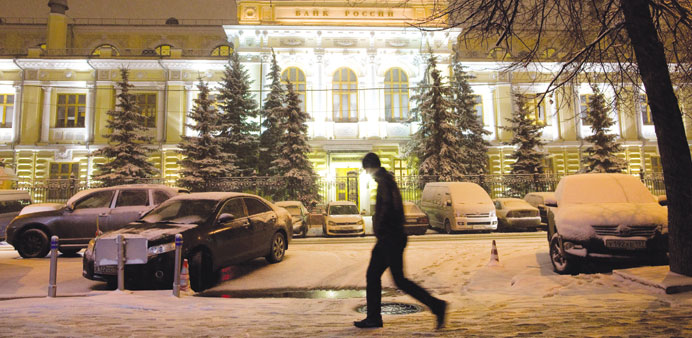
A pedestrian walks through snow past Russia’s central bank in Moscow. The apex bank raised its key rate by 50 basis points to 7.5% yesterday.
Russia unexpectedly raised interest rates for the second time in two months yesterday and suffered its first credit rating cut in five years, highlighting the impact of the Ukraine crisis on the teetering economy.
The central bank raised its key rate by 50 basis points to 7.5% to prevent a weakening rouble fuelling inflation.
“The central bank is indirectly trying to defend the rouble against the backdrop of credit ratings downgrade and the West’s tough rhetoric about the possibility of new sanctions against Russia,” said Dmitry Polevoy, an analyst at ING Bank in Moscow.
Both moves highlighted the impact on Russia’s weakening economy of the tense standoff with the West over Ukraine. President Vladimir Putin acknowledged this week that sanctions imposed in response to Russia’s annexation of Ukraine’s Crimea region last month are already hurting the Russian economy, thought not critically.
The West has threatened tougher sanctions, with US Secretary of State John Kerry warning Russia on Thursday that it would be making “an expensive mistake” if it did not change course over the Ukraine crisis.
The hike came less than two months after the central bank raised rate by an emergency 150 bps in early March. It said the move was due to accelerating inflation due to the weakening rouble and a rise in inflation expectations.
It said it did not intend to lower rates in the coming months.
S&P kept its outlook negative and stressed the impact of capital flight. Foreign investors withdraw $63.7bn from Russia in the first three months of the year.
“The tense geopolitical situation between Russia and Ukraine could see additional significant outflows of both foreign and domestic capital from the Russian economy and hence further undermine already weakening growth prospects,” it said.
The World Bank has estimated capital flight may reach a record $150bn this year. Economy Minister Alexei Ulyukayev dismissed the downgrade, saying, “Partially, it is kind of a politically motivated decision.”
But analysts said other rating agencies were likely to follow suit, and Russia’s already battered financial markets fell further yesterday.
The rouble briefly firmed after the rate hike but gave up all its gains and was last down 0.7% on the day at 36.02 to the dollar. The MICEX stock index fell 1%. “Russia is going backwards as reflected by developments in relations with Ukraine and the West,” said Timothy Ash, analyst at Standard Bank.
“(This is)... bad for growth (long term and short term), bad for investment, bad for capital flows, and bad for broader political, economic reform and institutional reform.
The central bank said the probability of inflation exceeding its 2014 target of 5% had increased significantly and the decision to raise rates would ensure that inflation stays now below 6% this year.
“The central bank is now skewed towards excessively tight monetary policies to earn market trust on its path to inflation targeting,” VTB Capital analyst Daria Isakova said in a note.
But analysts at BNP Paribas said, however, that the tight policy may not be enough to stop the rouble, which has lost nearly 9% against the dollar this year, falling further.
“The relatively minor increase in rates will do little to prevent further pressure on currency if the conflict in Ukraine continues escalating,” the analysts said in a note.
Russia’s $2tn economy grew 0.8% in the first quarter and the economy ministry has said growth may not exceed 0.5% this year. The central bank said the impact on growth of the rouble depreciation would be limited.
Analysts say Russia’s external financial position remains strong.
Its debt to GDP ratio stood at around 11% at the end of last year, compared to more than 100% among countries such as Italy or Greece.