


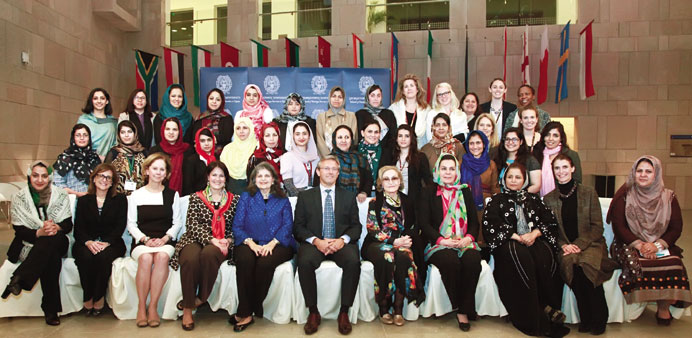
RAWLI members along with GU-Q dean Dr Gerd Nonneman (centre).
Rising Afghan Women Leaders Initiative (RAWLI) has been launched at Georgetown’s School of Foreign Service in Qatar (GU-Q) by the US-Afghan Women’s Council (USAWC) of Georgetown
University.
The initiative was designed under the Georgetown Leadership Academy to advance a core pillar of the USAWC’s mission to promote substantive and practical leadership development of Afghan women. RAWLI was offered to 22 Afghan women leaders and six Georgetown University students to support the development of their personal and professional leadership skills.
Under the direction of Dr Phyllis Magrab and Ellen Kagen of Georgetown University, RAWLI draws on their combined 34 years of leadership training experience. The group was welcomed by GU-Q Dean Dr Gerd Nonneman.
Fatema Gailani, president of the Afghan Red Crescent Society, remarked: “For me, these women are the security and the future of Afghanistan.”
RAWLI was realised through the generosity and steadfast commitment to Afghan women and children by Caroline Hudson Firestone; Abbott Laboratories; the Geraldine P Waldorf Fund at Georgetown University’s Centre for Child and Human Development and many USAWC members and partners.
The US-Afghan Women’s Council (USAWC) is a public-private partnership at Georgetown University. Founded in 2002, the council is co-chaired by president of Georgetown University John J DeGioia, and US ambassador-at-large for Global Women’s Issues Catherine Russell as well as by the Afghan minister of foreign affairs and Afghan minister for women affairs. Laura Bush and Hillary R Clinton are the council’s honorary co-chairs.
The mission of USAWC is to convene stakeholders, identify and mobilise public and private sector resources, and encourage dynamic and collaborative partnerships in support of Afghan women and children in the areas of education, health, economic empowerment, and leadership development.
USAWC members are leaders in government, private sector, academia, and philanthropy who undertake individual initiatives to advance the lives of Afghan women and children. The council works to address areas of need identified by Afghan women, convening interested partners and brokering connections to build meaningful, sustainable platforms.