


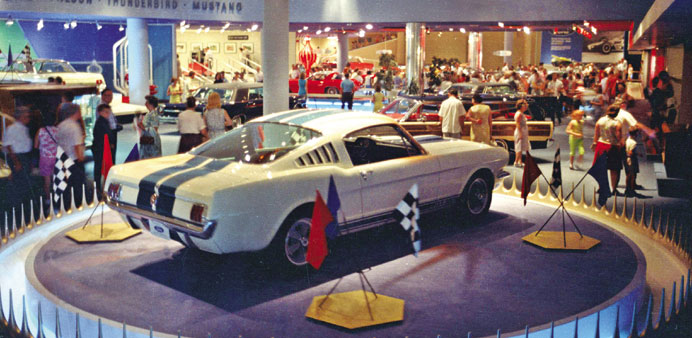
A 1965 Ford Mustang GT350 is shown in the Ford Pavilion at the 1964 World’s Fair in New York in this photo released yesterday. The car’s styling strikingly captured the exuberant youth culture of America in the early 1960s.
Next week’s 50th anniversary of the first Ford Mustang evokes a long-ago day when new cars could generate as much excitement, at least in America, as new iPads. The car caused a sensation, even though it wasn’t a technological marvel like Apple’s tablet.
Instead it was simply a smartly styled body mounted atop the underpinnings of a pedestrian compact car, the Ford Falcon. One Ford executive boasted, in the idiom of the day, that it was like “turning a librarian into a sexpot.” Yet with room for four, the Mustang was surprisingly practical.
The car’s styling strikingly captured the exuberant youth culture of America in the early 1960s - and its $2,368 price tag made it affordable to the horde of baby boomers that were just reaching driving age or heading off to college. That price was for the basic six-cylinder engine, but buyers could add extra-cost (and handsomely profitable) options, including an automatic transmission, air conditioning, convertible top and a 289-cubic-inch V8 engine.
American popular culture was gaining global reach in the early 1960s, and the Mustang went along for the ride. Over the years Mustang clubs were established in more than 150 nations, many of which opposed American policies but admired its lifestyle. With that kind of enduring global appeal, Ford has decided to sell the new 2015 Mustang globally for the first time, rather than make non-North American buyers specially import the car.
For the birthday next week, the Mustang Club of America is organising five-day celebrations at the Charlotte Motor Speedway in North Carolina and the Las Vegas Motor Speedway in Nevada, where thousands of Mustangs from each decade will meet.
The following account of the Mustang’s hyperbolic debut is excerpted from “Engines of Change”, a 2012 book by the managing editor of Reuters, Paul Ingrassia.
On the night of April 16, 1964, Ford blitzed the airwaves by buying the 9:30 to 10 pm slot (Eastern time) on all three American television networks to tout the Mustang. The company also bought ads in 2,600 newspapers, including special ads for the “women’s pages,” as they were then known, to celebrate the Mustang’s Tiffany Design Award, the first ever given to a commercial product. The official introduction came the next day, April 17, at the New York World’s Fair.
“Americans will have to be deaf, dumb, and blind to avoid the name,” declared Newsweek magazine. Archrival Time likened the Mustang to “a high-strung pony dancing to get started on its morning run.” The simultaneous and similar articles prompted backslapping in the Ford PR department, which had cajoled both sets of editors into heralding the new car, unbeknownst to each other. The new Mustang didn’t evoke praise from every publication. “The basic engine for the Mustang is the 170-cubic-inch Falcon six,” noted Car and Driver, “a piece of machinery about as exciting as a dish of baby food.” The magazine added: “The hood lands on the grille with a fit that reminds us of the lid on one of our mother’s more experienced sauce-pans.”
But the public didn’t seem to mind. One dealer in Texas had fifteen willing buyers for the only Mustang he had in stock. He auctioned the car to the highest bidder, who spent the night sleeping in the car to make sure no one else got it.
When a Mustang was displayed at a stock car race in Alabama, 9,000 fans surged over the retaining wall for a look, delaying the race almost an hour. In Seattle a cement-truck driver passing a Ford dealership turned to gawk at the Mustang, lost control of his truck, and crashed into the showroom. In Detroit, a man parked his vehicle in the doorway of a crowded dealership and ran in, blocking anybody else from entering. It took the dealer a half hour to find the man and make him move his car.
The first Mustang that Ford built was sold not in the US but in Newfoundland, Canada. Stanley Tucker, an airline pilot in the provincial capital of St John’s, bought the only Mustang the local Ford dealer had in stock. For weeks his was the only Mustang in the province. Children who saw him driving would wave and shout “Mustang!”
That was a frequent occurrence south in the States, too, where kids whose fathers brought home the first Mustang on the block would remember the day decades later. “It turned mom from a 33-year-old mother into a free-spirited co-ed,” recalled John Hitchcock, whose father, a Ford purchasing manager in suburban Detroit, delighted his wife with a dark-green Mustang convertible. Janette Hitchcock never went back to driving station wagons. Ford targeted women like her with an advertisement showing an attractive young housewife loading groceries into her Mustang. The headline read, “Sweetheart of the Supermarket Set.”
The advertising aimed at men, meanwhile, was hormonal instead of cerebral. “A car to make weak men strong, strong men invincible,” declared one ad that showed a smiling man sitting in front of his Mustang. Another Mustang ad said, “Wolfgang used to give harpsichord recitals for a few close friends. Then he bought a Mustang . . . Being a Mustanger brought out the wolf in Wolfgang.”
What most surprised Ford executives was the Mustang’s appeal across generations. The median age of Mustang buyers was thirty-one. But one buyer in six was between forty-five and fifty-four, many of them people like Jack Ready Sr.
Ready had a tough time growing up in the Depression, and he saw heavy action in World War II as a side-gunner in big bombers flying over Germany. In 1964 he was a 45-year-old school principal in Westport, Connecticut, and a straitlaced veteran who still sported his military haircut. True to form, he had driven Detroit’s lumbering but practical station wagons for years.
So the Ready clan was stunned when, right after the Mustang went on sale, Jack Sr. announced he was getting one. It was a convertible in British racing green with a black interior, a white top, the top-of-the-line V8 engine, and a floor-mounted automatic transmission. No one in the family had seen such a car before.
“Buying the Mustang was completely antithetical to anything he had ever done,” recalled his son Jack Jr., who was 12 at the time. “It came completely out of the blue.” The family gave Jack Sr. an ascot tie to wear, and he went cruising in the Mustang with the ascot on and the top down.