


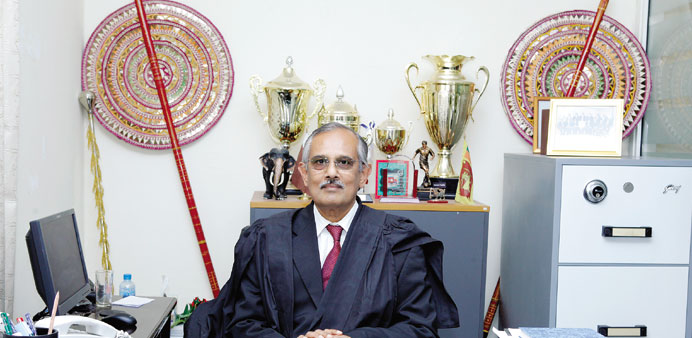
NEW VISTAS: Principal Rienzie Nanayakkara is seen at his office in Stafford Sri Lankan School Doha.
By Umer Nangiana
A school that started with a nursery of 25 students in 2001 is imparting quality education to over 600 students today. Facing severe shortage of space, Stafford Sri Lankan School Doha (SSLSD) is striving hard to carry forward its founders’ mission of making quality education available for all.
Besides A-Levels, SSLSD now offers education from Lower Reception to Advanced Level. The school follows the Edexcel Curriculum. Students in Year 2 and Year 6 sit for the Key Stage I & II (SAT) examinations administered by Edexcel UK.
SSLSD Principal Rienzie Nanayakkara spoke to Community about how the school was planning to tackle the space problem besides modernising the teaching methods.
Shortage of space has been a long-standing issue. How do you plan to tackle this problem?
This is a major problem. This premises we had obtained from a person who had been quite concerned about the needs of the Sri Lankan community. It was an abandoned building of a former Algerian school, so we pooled in and borrowed money and brought it up to this level. According to Supreme Education Council (SEC) requirements, we can accommodate only 650 students here but there has been a great demand for admissions. About 200 more students are in the waiting list. So we are looking for other property adjacent to the school to accommodate new admissions. We have put up a circular on the notice board saying that admissions for the next batch will depend on space.
Is there a permanent solution?
The government has offered us a piece of land on lease. We are in process of finalising it. It needs the signatures of Sri Lankan embassy. They will have to forward it to Colombo to get the approval. So once it is done we will raise money by the way of loans and grants. It will take about 2 to 3 years. But it is a must because the Sri Lankan community is growing.
How do you manage finances to run the school? Is it expensive?
No, we in fact cater to low-income middle-class community. We have a mix of students, those whose fees are paid by their parents’ employers for instance and those whose parents cannot afford to pay even the lowest fee structure but we accommodate them too. We do not deprive them of education. We have about 10-15 such students.
The school is a not-for-profit venture. Whatever we get by way of fees is plowed back to the school so we break even our resources. We do not make any profits.
Do you get any support from the Sri Lankan government?
No. We have affiliation with the Sri Lankan embassy in Doha which is a requirement to get the licence. But the school is self-sustained. We have multi-ethnic population but mainly (about 95%) Sri Lankan.
Your students sit for IGCSE and GCE examinations, what is the success ratio and how do you maintain such high standards?
We have a very dedicated lot of teachers who believe in much more than just class-room teaching. It is not ‘chalk-and-board’ teaching anymore. We have e-learning systems. Students have access to lectures at their homes. We have free of charge classes for weak students. We promote extra-curricular activities such as debating, music, dance etc.
For instance, our 9-graders recently took a field trip to Sri Lanka, part of which was to help remote schools, we gave them computers we had removed from here. We provide this kind of exposure to students with limited resources. We do not have much money and teachers are not paid as much as compared to British or other expatriate schools but we give them accommodation and other facilities within our means. The teachers have also given their best. Next year, we will have students sitting for A-Levels exams and we have already set very high standards for them. We are aiming at ‘A’ grades.
What is the e-learning system? How does it work?
It is compulsory for the teachers to upload all the lectures on the system. Parents are briefed in advance that lessons are uploaded so if they want to consult they can download from there.
You need a huge set-up then?
No, in fact, the lesson plan is uploaded at beginning of the year upfront. Then, every week we upload the segment of the lesson. So once you are done with the first level, next year it is only to be fine tuned. It has been very successful.
We are going to provide same facility for language courses in Tamil and Sinhalese because most students here have no other facility to learn their mother tongue. It is a requirement for entering universities in Sri Lanka.
Stafford students have been performing well in extra-curricular activities, particularly drama. What is the secret of this success?
We have some competent teachers. One female teacher, in particular, has staged some excellent dramas. Our students made public performances in Sri Lanka. Our standards are at par with Doha College and Newton School. In fact we had beaten Cambridge School in English debating second round. And we were champions in inter-school Scrabble competitions recently. It is the teachers who work with the students sometimes for 10-12 hours and coach them.
How do you keep up with modern technological advancements in the field?
To tell you the truth, we depend heavily on other established schools to get their access material and unused equipments. We interact with affluent schools. Sometimes when they have to replace their furniture, they give it to us and we use it. The American Women Association agreed to give us books and smart boards. We have to depend on donors. But we have frequent exchanges with Doha College, Birla School, Pakistani schools to keep up with modern trends. They benefit from us and we benefit from them.
Ours students have gone to take admissions in US universities or good universities back in Sri Lanka.
We want to provide more opportunities to students by introducing different subjects and remaining not only confined to Edexcel subjects but for that we need to have better facilities. This is the main constraint.
How has been your stay in Doha?
I am quite happy with the facilities provided by the government. They are deeply concerned about the education of expatriate students and we are very much thankful to them.
BELOW:
The SSLSD campus.