


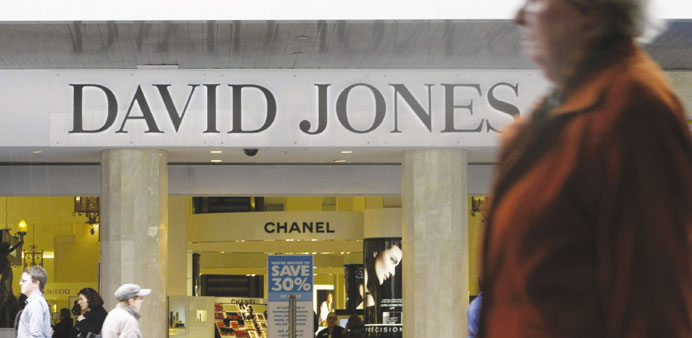
Pedestrians walk past a David Jones department store in central Melbourne. Woolworths’ acquisition of David Jones, the biggest for the South African company to date, would create a leading southern hemisphere retailer.
South African retailer Woolworths Holdings is set to buy struggling Australian department store operator David Jones for $2bn after trumping an offer from Myer Holdings, it was announced yesterday.
The acquisition, the biggest for the South African company to date, would create a leading southern hemisphere retailer that will benefit from greater scale and a common fashion seasonality, it said.
Woolworths Holdings, which has no relationship with Australian supermarket chain Woolworths, already has experience in the Australian market, owning 88% of upmarket clothing retailer Country Road as well as another clothing chain Witchery. A company spokesman said it would avoid using its Woolworths brand in Australia to avoid any clash with the local company of the same name. The deal also provides David Jones, which has seen profits decline for the past three years as competition from overseas players heats up, with more expertise in online offerings and private brands.
Resilient consumer spending, fuelled by a strong local currency and record low interest rates, has encouraged the likes of Sweden’s Hennes & Mauritz, and Japan’s Fast Retailing, the operator of the Uniqlo clothing chain, to set up shop in Australia.
“The view that we take as a business is that the department store isn’t dead - mediocrity is dead,” Woolworths’ chief executive, Ian Moir, said at a briefing in Sydney. “In short, we’re buying this business to build a bigger southern hemisphere brand.”
Woolworths Holdings, an upmarket retailer which operates department stores, clothing stores and a supermarket chain in South Africa, is offering A$4 a share in cash for David Jones, Australia’s second-largest department store, a 25% premium to Jones’s closing share price on Tuesday and a 40% premium to its close on Jan. 30, when the Myer offer was made public.
Woolworths said it will fund the acquisition with a mix of equity and debt with plans to make a share offer in South Africa and raise new debt in both the Australian and South African markets. The company declined to say how much new capital it intended to raise.
The offer, which has the backing of the David Jones’s board, is slightly above the company’s intrinsic value of $3.51, according to Thomson Reuters StarMine, which projects how much a stock should be worth based on expected earnings growth over the next five years.
“This makes a huge amount of strategic sense. They can afford to pay a high multiple,” said Commonwealth Bank retail analyst Andrew Mclennan. “There is going to be big synergies coming from this transaction.” Woolworths’ profits have grown 20% a year in the past five years on the back of investments in product development, tighter inventory management and through onlines sales, and the company plans to bring this expertise to David Jones, Moir said.
He estimated that the company could add at least A$130mn annually to David Jones’ bottom line within five years.
David Jones posted an annual profit of A$95.2mn in the last financial year. Its shares jumped to match the bid price but later pared gains slightly to end the day 23% higher at A$3.91.
The offer prompted Myer, Australia’s biggest department store operator, to withdraw its all-share proposal that valued David Jones at A$1.7bn as of Tuesday’s closing price, and which it had promoted as a merger of equals.
In 2013, in US dollars, Woolworths revenue was $3.6bn and David Jones was $1.7bn, putting their combined sales above Myer’s $2.9bn. “What we are seeing is like a global consolidation of retail,” said Morningstar analyst Tim Montague-Jones.
“That’s increasingly seeing stronger retail models expand offshore and take market share from weaker ones. It’s all about scale,” he said, noting Myer would be left in a much weaker competitive position.
Shares in Myer ended 3.9% higher, however, on relief that it would not be overstretching itself in seeking a deal.
Woolworths’ Australia expansion is in sharp contrast to international and South African retailers, which are moving into the rest Africa, a poor but fast-growing continent touted as the next bright growth spot for retailers.
Africa was thrust into the retail spotlight three years ago when Wal-Mart Stores paid $2.4bn for a controlling stake in Massmart Holdings, giving it a foothold in several sub-Saharan countries.